
Frequently asked questions about law enforcement in health care settings.

Pediatric Emergency Medicine fellowship

Pediatric Emergency Medicine fellowship

Welcome to the Pediatric Emergency Medicine (PEM) fellowship program at Children’s Minnesota. You have chosen to explore one of the country’s premier PEM fellowship programs. Since 1989, we have trained fellows to be experts in the field of pediatric emergency medicine. We work hard to provide an environment where fellows gradually increase their confidence and medical knowledge, learn valuable management and teaching skills, and advance their understanding of clinical research.

Get details about the PEM fellowship

Get a look inside Children’s Minnesota

Learn more about what makes our program exceptional:

The Department of Pediatric Emergency Medicine is comprised of our staff physicians, nurse practitioners, and ancillary staff. Both of our main hospitals are staffed 24/7/365 with BC/BE PEM physicians. In addition to a wide array of pediatric subspecialists, we have numerous resources available in our emergency departments including interpreter services, social services, child life specialists, pharmacists, respiratory therapists and research assistants.

  • Proudly sponsored by HealthPartners Institute in partnership with Region’s Hospital, which also houses the Emergency Medicine Residency. The Office of Health Professional Education at HealthPartners provides institutional resources and support to our program.
  • Our PEM Fellowship provides the opportunity to work at both the Minneapolis and St. Paul Children’s campuses, which see a combined total of more than 90,000 patient visits per year.
  • Our Minneapolis campus is the only free-standing children’s hospital in the region that provides level I trauma services in a pediatric-specific setting verified by the American College of Surgeons. In addition to our trauma program, the Minneapolis campus includes the primary centers for Hematology/Oncology program, Neurology and Neurosurgery, Orthopedics, and Cardiology.
  • Children’s St. Paul is the oldest children’s hospital in the state. It serves as the focal point for our programs in Mental Health, Diabetes and Endocrinology, and Eating Disorders.
  • Regions Hospital serves as the training site for rotations in adult emergency medicine, emergency medical services and toxicology. It is a designated level 1 trauma center for adults and pediatric patients in St. Paul. Regions Hospital also serves as a Burn Center for St Paul and the east metro.
  • Our program includes 9 fellows, with support from over 50 board certified PEM physicians.

Our leadership

Emergency department leadership

Our fellowship program emphasizes the ACGME six core competencies (patient care, medical knowledge, practice-based learning, interpersonal skills, professionalism, and systems-based practice). The following goals will be accomplished through a variety of activities during the course of the fellowship:

Clinical

  • Develop skills in initial assessment, resuscitation, stabilization and early management of pediatric emergencies.
  • Gain broad knowledge and skills in common and uncommon pediatric emergencies.
  • Become competent in the assessment and management of pediatric trauma.
  • Master bedside ultrasound and understand its applications in pediatric emergency medicine.
  • Acquire necessary skills in the field of adult emergency medicine and trauma.

Teaching

  • Develop effective bedside and didactic teaching skills, for use with families, medical trainees, as well as teaching within the wider medical community.
  • Learn to use Simulation as teaching tool for procedural competence and improving communication skills.
  • Opportunities may include becoming PALS instructor and presenting and educating at conferences throughout the community.

Research

  • Develop a foundation in the research process through formal training and collaboration with our research team, including coordinators, managers, research assistants, and statisticians.
  • Gain experience in project development, methodology, analysis, manuscript preparation, conference submissions, and grant writing.
  • Develop a strong understanding of statistics and epidemiology, as applied in PEM.
  • Complete a written scholarly project, as required for board certification by the American Board of Pediatrics.

Ultrasound track

  • Provides an optional area of specialization for fellows with an interest in point of care ultrasound
  • Track starts in the second half of first year and includes 4 extra hours of scanning time per week.
  • Additional experiences available with ultrasound techs, echo techs, vascular access staff, and ultrasound trained faculty.
  • Monthly ultrasound reviews with the ultrasound director (held on one didactic day per month).
  • Teaching experiences at resident and fellow didactic days, with rotating residents, and at local and national conferences.
  • Learn administrative roles needed to be an ultrasound director.
  • Ultrasound related scholarly project and opportunities for publication available.

Disaster medicine track

  • Children’s Minnesota is a core member of Region V for Kids, a federally funded Pediatric Disaster Center of Excellence by HHS and ASPR.
  • The disaster preparedness track provides fellows an opportunity to specialize in disaster medicine with core curriculum in topics such as: triage, mass casualty incident, decontamination, reunification, and behavioral health.
  • Fellows will work closely with the disaster medicine medical directors in developing and updating disaster policies and procedures.
  • Fellows will gain practical skills in disaster simulation and exercise with core participation in regional exercises and training.
  • Fellow will have local, national, and global networking opportunities with strong support for scholarly activities with a required disaster research project.

Rotation curriculum

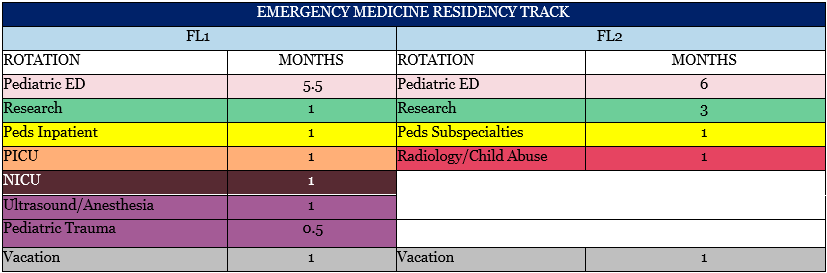
Fellows who have previously completed an EM residency operate on a two-year curriculum. Those who have completed a Pediatric residency function as a junior faculty in their second and third year. There is more than sufficient time and support to complete all requirements of the ABP and ACGME relevant to fellowship.

During emergency medicine rotations, fellows spend time in both of our pediatric emergency departments. Shifts vary to allow for diverse experiences, includes being an active participant and leader in traumas and medical resuscitations. In addition to standard shifts, fellows will have opportunities to complete ultrasound scanning shifts and procedure shifts to practice procedures such as suturing, foreign body removal, nail bed repairs and blocks.
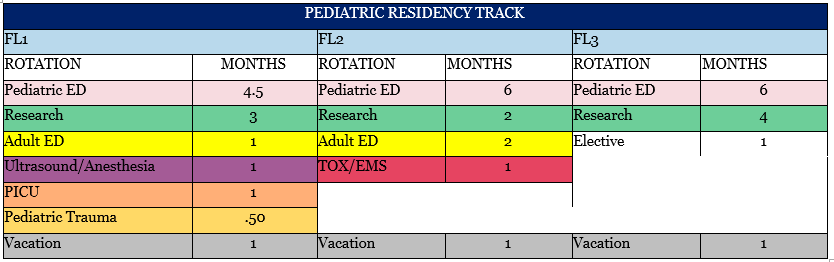
Pediatric residency track chart showing number of months per rotation.

Emergency medicine residency track chart, showing the number of months per rotation.

Didactics

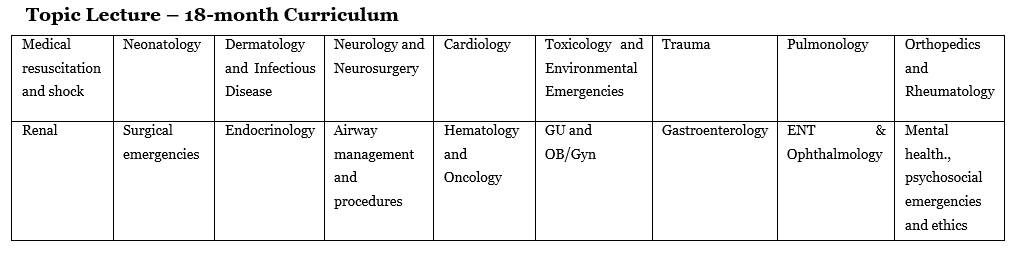
Our fellows have protected education days every month. Some of our conferences are in collaboration with Region’s Hospital. Fellows have opportunities to teach or present cases at these conferences throughout the year.
Conferences

  • Trauma Grand Rounds (combined with Region’s EM Residency)
  • Pediatric Critical Case Presentation (combined with Region’s EM Residency)
  • PEM Board Review
  • Simulation
  • Ultrasound teaching/skills
  • Case Discussion
  • PEM Journal Club
  • Pediatric Trauma Review
  • Children’s PEM Staff Meeting Case Presentation
  • Faculty/Fellow Lectures
  • Research, Epidemiology and Statistics conferences
  • University of Minnesota, Smiley’s Family Medicine Lecture (annually)
  • Hospital-wide Disaster Drill Simulation (annually)

Additional training

Our fellows have the opportunity to attend a number of other training courses, conferences, national meetings, and credentialing courses. CME or Department funds are available to cover the cost of course fees, national meetings, certifications, and professional society memberships. We have adequate funds to cover travel to an additional conference. CME specific money is also available for textbooks and/or computer software (i.e. board preparation)

We seek physicians who have completed three years of training in an ACGME-approved pediatrics or emergency medicine residency. Our PEM fellowship participates in the pediatric specialties fall match through the National Resident Matching Program (NRMP).

We accept applications through ERAS from July 15–August 30. After review of completed applications, interviews will be offered to select applicants and scheduled accordingly. Interviews typically take place in September and October.

  • Completed ERAS application
  • Three (3) letters of recommendation, with at least 1 being from a pediatric emergency medicine attending
  • Residency program director letter of recommendation and verification that applicant is in good standing
  • One-page personal statement
  • Results of USMLE testing

Please note: Our program is listed in FREIDA under Pediatric emergency medicine and the name of our sponsoring institution, HealthPartners Institute / Children’s Minnesota. You may also search for us using our program ID (1142631025).

PEM fellows work closely with our Design & Analytics Team (PhD level biostatisticians), clinical research coordinators (IRB and grant support), and research assistants. We have numerous ongoing projects in our department and there are ample opportunities for our fellows to pursue their research interests. In addition, our site participates in PEDSnet, the AAP Pediatric Emergency Medicine Collaborative Research Committee (PEMCRC), and the Pediatric Emergency Research Network (PERN). Motivated fellows have the opportunity to pursue projects within these research networks.

Academic faculty

A number of our faculty are dedicated to academics and have devoted time for clinical research and/or teaching. These faculty serve as mentors for fellowship projects, and will guide fellows through the process of project development, IRB submission, data collection and analysis, and final composition. Our main areas of research include point-of-care ultrasound utilization, management of diabetic emergencies, appendicitis, trauma, and measurements of social determinants of health. In total, our academic faculty have well over 100 publications. We are a highly motivated research group, and encourage fellows to submit their projects for publication.

Class of 2027

Amanda Lee, MD
Residency: UT Health San Antonio (Pediatrics)
Medical School: University of Texas Health Sciences Center at San Antonio

Alaa Saeed, MD
Residency: Woodhull Medical Center (Pediatrics)
Medical School: University of Khartoum Faculty of Medicine

Taylor Wells, MD
Residency: University of Minnesota (Pediatrics)
Medical School: University of Minnesota Medical School

Class of 2028

Taylor Beavens, MD
Residency: University of Minnesota (Pediatrics)
Medical School: Creighton University School of Medicine

Aditi Hindka, DO
Residency: University of Michigan – Ann Arbor (Pediatrics)
Medical School: Alabama College of Osteopathic Medicine

Vitaliy Perepelitsa, DO
Residency: University of Minnesota (Pediatrics)
Medical School: Des Moines University College of Osteopathic Medicine

Class of 2029

Devin Clark, MD
Residency: University of Minnesota (Pediatrics)
Medical School: University of Rochester School of Medicine

Nita Narh, MD
Residency: Marshfield Clinic Health (Pediatrics)
Medical School: American University of Barbados School of Medicine

Alecia Vang
Residency: University of Minnesota (Pediatrics)
Medical School: University of Wisconsin School of Medicine

Class of 2026

  • Elizabeth Chiquoine, DO (Children’s Minnesota – Minneapolis, MN)
  • Tyler Ellis, MD (Children’s Minnesota – Minneapolis, MN)
  • Smrithi Krishnamohan, MD (Manning Family Children’s – New Orleans, LA)

Class of 2025

  • Rachel Hedstrom, MD (Children’s Minnesota – Minneapolis, MN)
  • Autumn Montville, MD (Children’s Minnesota – Minneapolis, MN)

Class of 2024

  • Bergthor Jonsson, MD (Akureyri Hospital – Iceland)
  • Brian Lefchak, MD (University of Minnesota-Hennepin Healthcare for Clinical Informatics Fellowship / Children’s Minnesota for PEM moonlighter)
  • Taryn Raschein, MD (Phoenix Children’s – Phoenix, AZ)

Class of 2023

  • Marshal Khant, DO (Mary Bridge Children’s Hospital – Tacoma, WA)
  • Ariel Stein, MD (Children’s Minnesota – Minneapolis, MN)
  • Devan Van Lanen-Wanek, MD (Maria Fareri Children’s Hospital – Valhalla, NY)

Class of 2022

  • Joanna Ekstrom, MD (Children’s Minnesota – Minneapolis, MN)
  • Tanya Paul, MD (Dayton Children’s Hospital – Dayton, OH)
  • Alexandra Riggs, MD (Children’s Medical Center Plano – Plano, TX)

Class of 2021

Class of 2020

  • Vivianne Tchonang Leuche, MD (University of Minnesota Masonic Children’s Hospital – Minneapolis, MN)
  • Jonathan Nielsen, MD (University of Texas Southwestern – Dallas, TX)
  • Normaliz Rodriguez, MD (John’s Hopkins All Children’s – St. Petersburg, FL)

Class of 2019

Class of 2018

  • Saydi Chahla, MD (Children’s Minnesota – Minneapolis, MN)
  • Carly Theiler, MD (University of Iowa – Iowa City, IA)
  • Gena Cooper, MD (University of Kentucky – Lexington, KY)

Class of 2017

  • Meghan Cain, MD (Mayo Clinic – Rochester, MN)
  • Michael McWay, MD (Children’s Hospital of Philadelphia – Philadelphia, PA)
  • David Piechota, MD (Essentia Health St. Mary’s – Duluth, MN)

Contact us

Have questions about the Pediatric Emergency Medicine fellowship at Children’s?

Give to Kids Day

Today is Give to Kids Day!

A day for our generous community to join together to ensure that even the tiniest hearts get the strongest possible start.