
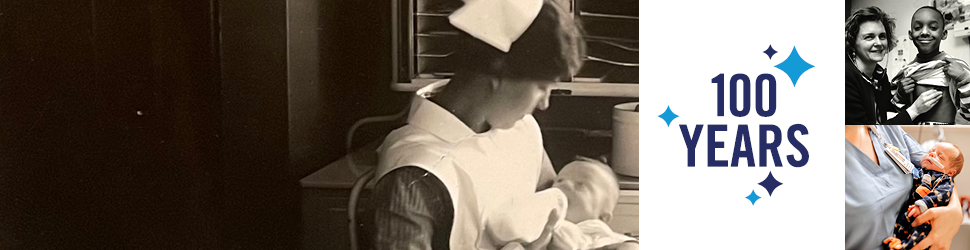
In honor of our 100th anniversary, every month in 2024 we’re sharing stories and images from the Children’s Minnesota archives. Each month will feature a different decade. Here we continue with the 1990s.
The 1990s saw a seismic shift. It’s when our two hospitals, each with their own distinct origins, cultures and staffs, merged to become one health system. The1990s also saw a successful separation that made for some heartwarming headlines.
Jump back in time and read about Children’s Minnesota in the 2010s, 2000s, 1980s, 1970s, 1960s, 1950s, 1940s, 1930s and the 1920s.
The 1990s
A merger of equals
By 1990, our Children’s Hospital of St. Paul had been serving kids as an independent organization for more than 65 years. On the other side of the Mississippi River, our Minneapolis Children’s Health Center had been serving kids for 17 years, also as an independent entity. It wouldn’t be long though, until leaders of both hospitals started to see how a merger might make sense. As explained in a 1992 report, a merger of the two hospitals would:
- Reduce overhead costs.
- Minimize the duplication of services and technology.
- Strengthen the ability of both hospitals to serve children throughout the region.
- Create a stronger force to advocate for and support legislative and community efforts that benefit children.
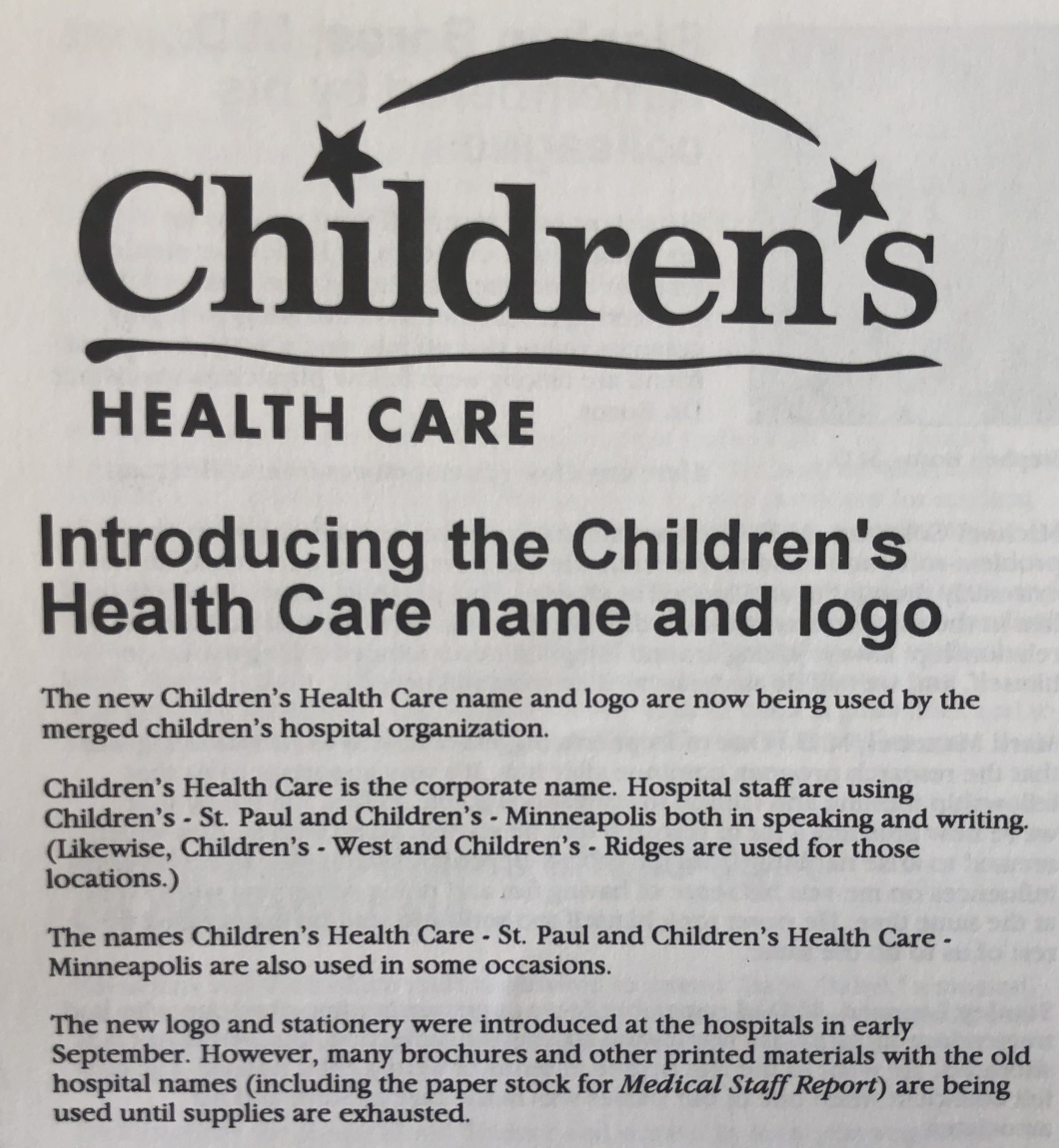
“We needed critical mass in order to do our best for children. By joining forces, we could achieve that critical mass,” said Brock Nelson. Nelson served as CEO of Children’s Hospital of St. Paul for 11 years before serving as the first CEO of the newly merged organization, Children’s Health Care.
There were some rocky moments in the merger process. Some staff were laid off. The Minnesota Attorney General was concerned that the merger would cause a decrease in choice for families seeking pediatric care. The merger was able to move forward after the two hospitals negotiated a compromise with the Attorney General’s office.
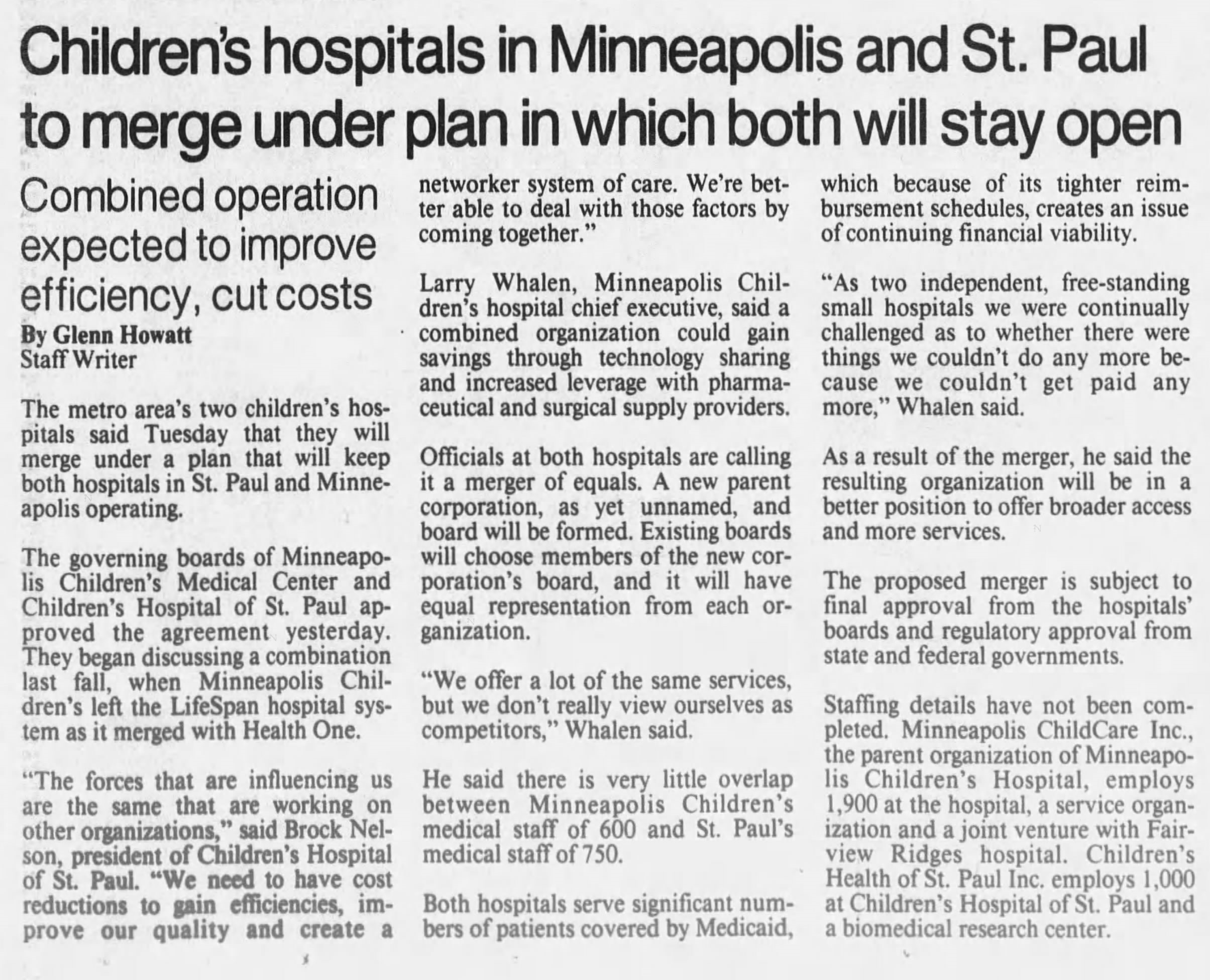
Children’s hospitals in Minneapolis and St. Paul to merge under plan in which both will stay open
Combined operation expected to improve efficiency, cut costs
By Glenn Howatt
Staff Writer
The metro area’s two children’s hospitals said Tuesday that they will merge under a plan that will keep both hospitals in St. Paul and Minneapolis operating.
The governing boards of Minneapolis Children’s Medical Center and Children’s Hospital of St. Paul approved the agreement yesterday. They began discussing a combination last fall, when Minneapolis Children’s left the LifeSpan hospital system as it merged with Health One.
“The forces that are influencing us are the same that are working on other organizations,” said Brock Nelson, president of Children’s Hospital of St. Paul. “We need to have cost reductions to gain efficiencies, improve our quality and create a networker system of care. We’re better able to deal with those factors by coming together.
Larry Whalen, Minneapolis Children’s hospital chief executive, said a combined organization could gain savings through technology sharing and increased leverage with pharmaceutical and surgical supply providers.
Officials at both hospitals are calling it a merger of equals. A new parent corporation, as yet unnamed, and board will be formed. Existing boards will choose members of the new corporation’s board, and it will have equal representation from each organization.
“We offer a lot of the same services, but we don’t really view ourselves as competitors,” Whalen said.
He said there is very little overlap between Minneapolis Children’s medical staff of 600 and St. Paul’s medical staff of 750.
Both hospitals serve significant numbers of patients covered by Medicaid, which because of its tighter reimbursement schedules, creates an issue of continuing financial viability.
“As two independent, free-standing small hospitals we were continually challenged as to whether there were things we couldn’t do anymore because we couldn’t get paid any more,” Whalen said.
As a result of the merger, he said the resulting organization will be in a better position to offer broader access and more services.
The proposed merger is subject to final approval from the hospitals’ boards and regulatory approval from state and federal governments.
Staffing details have not been completed. Minneapolis ChildCare Inc., the parent organization of Minneapolis Children’s Hospital, employs 1,900 at the hospital, a service organization and a joint venture with Fairview Ridges hospital. Children’s Health of St. Paul Inc. employs 1,000 at Children’s Hospital of St. Paul and a biomedical research center.
The merger was also met with trepidation by some staff, remembers Phil Kibort, former Children’s Minnesota chief medical officer.
“St. Paul was afraid they were going to lose their close-knit, family-like culture. Minneapolis was concerned about preserving their culture of specialists. In the end, I think we ended up with the best of both,” Kibort said.
An agreement, which both hospitals called “a merger of equals,” was finalized in June 1994. But it took longer to fully integrate.
“It didn’t happen overnight. The merger took work and a lot of mixing of different cultures much like the cities of St. Paul and Minneapolis themselves. We had a culture committee dedicated to helping us grow together. It was sad at times, though, when a newly merged service needed just one manager and someone had to go. There were, for over a decade, a lot of shifting sands,” recalled Patsy Stinchfield, RN, MS, CPNP-PC and former senior director of Infection Prevention and Control at Children’s Minnesota.
A successful and “extremely rare” separation
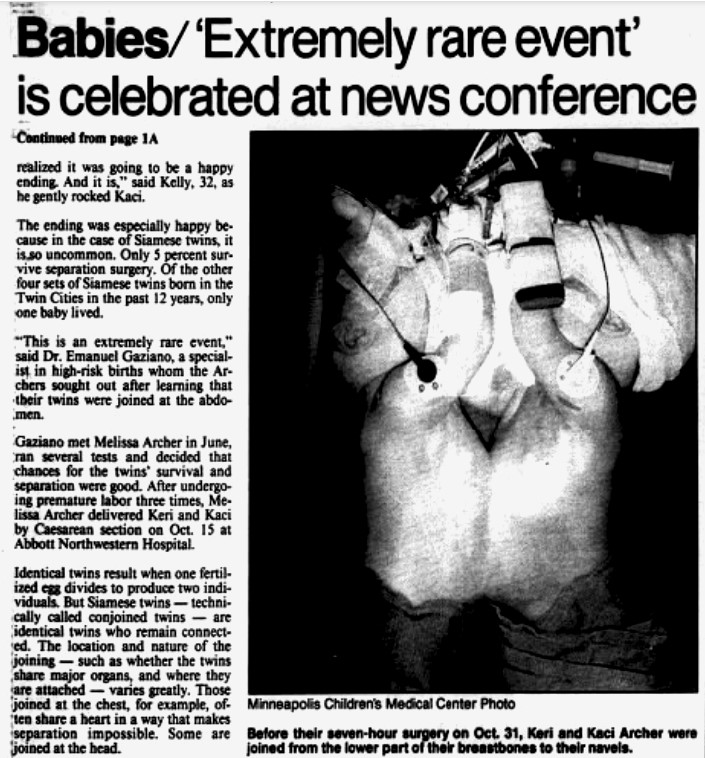
One of the more unique and celebrated surgeries of the decade happened in 1991 when conjoined twin girls underwent a successful separation procedure at our Minneapolis Children’s Medical Center (MCMC).
For seven hours a team of 12 – doctors, nurses and anesthesiologists – worked to separate 12-week-old Keri and Kaci Archer, who were joined from their belly button to their breastbone. The only organ they shared was their liver.
One of the surgeons, Dr. Hampton Rich, said this was the first surgery of its kind at MCMC.
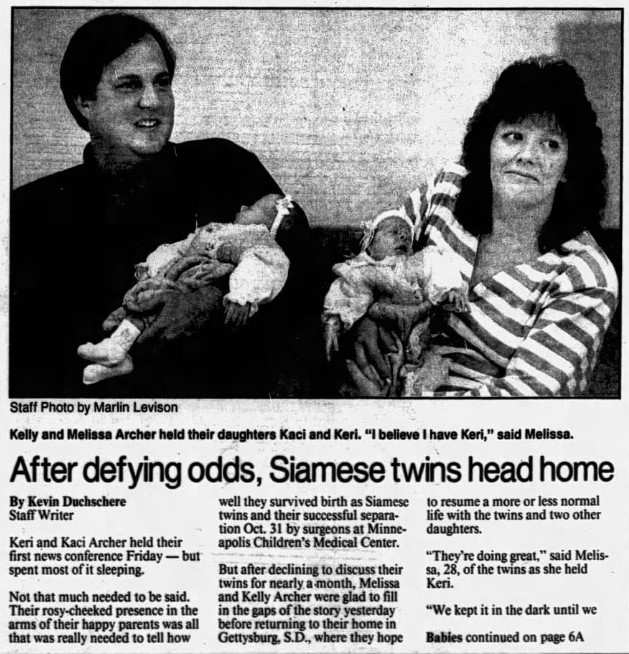
After defying odds, Siamese twins head home
By Kevin Duchschere
Staff Writer
(Please note: Some language used in this article is considered offensive today.)
Keri and Kaci Archer held their first news conference Friday – but spent most of it sleeping.
Not that much needed to be said. Their rosy-cheeked presence in the arms of their happy parents was all that was really needed to tell how well they survived birth as Siamese twins and their successful separation Oct. 31 by surgeons at Minneapolis Children’s Medical Center.
But after declining to discuss their twins for nearly a month, Melissa and Kelly Archer were glad to fill in the gaps of the story yesterday before returning to their home in Gettysburg, S.D., where they hope to resume a more or less normal life with the twins and two other daughters.
“They’re doing great,” said Melissa, 28, of the twins as she held Keri.
“We kept it in the dark until we realized it was going to be a happy ending. And it is,” said Kelly, 32, as he gently rocked Kaci.
The ending was especially happy because in the case of Siamese twins, it is so uncommon. Only 5 percent survive separation surgery. Of the other four sets of Siamese twins born in the Twin Cities in the past 12 years, only one baby lived.
“This is an extremely rare event,” said Dr. Emanuel Gaziano, a specialist in high-risk births whom the Archers sought out after learning that their twins were joined at the abdomen.
Gaziano met Melissa Archer in June, ran several tests and decided that chances for the twins’ survival and separation were good. After undergoing premature labor three times, Melissa Archer delivered Keri and Kaci by Caesarean section on Oct. 15 at Abbott Northwestern Hospital.
Identical twins result when one fertilized egg divides to produce two individuals. But Siamese twins – technically called conjoined twins – are identical twins who remain connected. The location and nature of the joining – such as whether the twins share major organs, and where they are attached – varies greatly. Those joined at the chest, for example, often share a heart in a way that makes separation impossible. Some are joined at the head.
The Archer twins, who were facing each other, were joined from the lower part of their breastbones to their navels. However, they did not share any major organs; only their livers were fused. Together, they weighed 12 pounds, 15 ½ ounces.
On Oct. 31, as the Archers waited in a nearby room, a team of five surgeons, two anesthesiologists and five nurses worked seven hours to separate Keri and Kaci. Since each had her own circulatory and respiratory system, they needed to be anesthetized individually.
The most delicate part of the operation was cutting apart the livers, said Dr. Hampton Rich, who led the surgical team. After opening the abdominal wall and cutting through the breastbone cartilage, the team spent an hour separating the livers.
Said Rich: “What we worried about was the drainage system of the liver (which secretes bile). We knew that each twin had her own gallbladder and assumed that each had her own drainage system. If they didn’t, we could have reconstructed (it)…but we didn’t have to.”
The liver of each twin is of a normal size, if slightly misshapen. Rich said that shouldn’t cause any long-term problems. In the end, all that will remain of their union are stomach scars.
“I’m delighted by the results,” Rich said. “I think this is something every pediatric surgeon dreams of doing once in his lifetime.” He added that this was the first time surgeons had attempted to separate Siamese twins at the medical center.
About one in every 80,000 births results in Siamese twins, according to national estimates. Minnesota has about 67,000 live births a year; the nation has about 4 million. This would indicate about one set of Siamese twins a year in Minnesota and several dozen across the nation. But many Siamese twins die shortly after birth and others are stillborn, and those cases often don’t come to public attention.
No national figures are available on the number of surgical separations.
For the Archers, the biggest problem now is telling the twins apart. “I believe I have Keri,” Melissa Archer said, introducing her daughter to the media.
Kelly Archer, his voice trembling and his face flushed with emotion, thanked the medical staff, and friends and strangers who had sent them letters or donated blood.
Asked how the couple had coped with the stress of having Siamese twins, Kelly responded, “It’s human nature to deal with it one day at a time…
“If you thought of the whole scope, I think it could boggle your mind….It was a day-to-day deal and we knew we were going to get through it, no matter what the outcome.
“I’m not real religious, but I was raised religious, and I believe our prayers gave the doctors the skill to help us out,” said Kelly, who runs an auto repair business in Gettysburg.
The babies, dressed in matching jumpers and headbands, were still snoozing. Rich was asked if they felt any pain. “I think they’re pretty comfortable,” he said smiling.
Then it was time for the Archers to leave on their 350-mile trip home, for what they said would be “a joyous celebration” and the first meeting for Kristin, 6, Kami, 4, and their new sisters. They bundled the twins into the back seat of the car.
“This will be the first night at home where we take care of them,” Melissa Archer said.
Going paperless
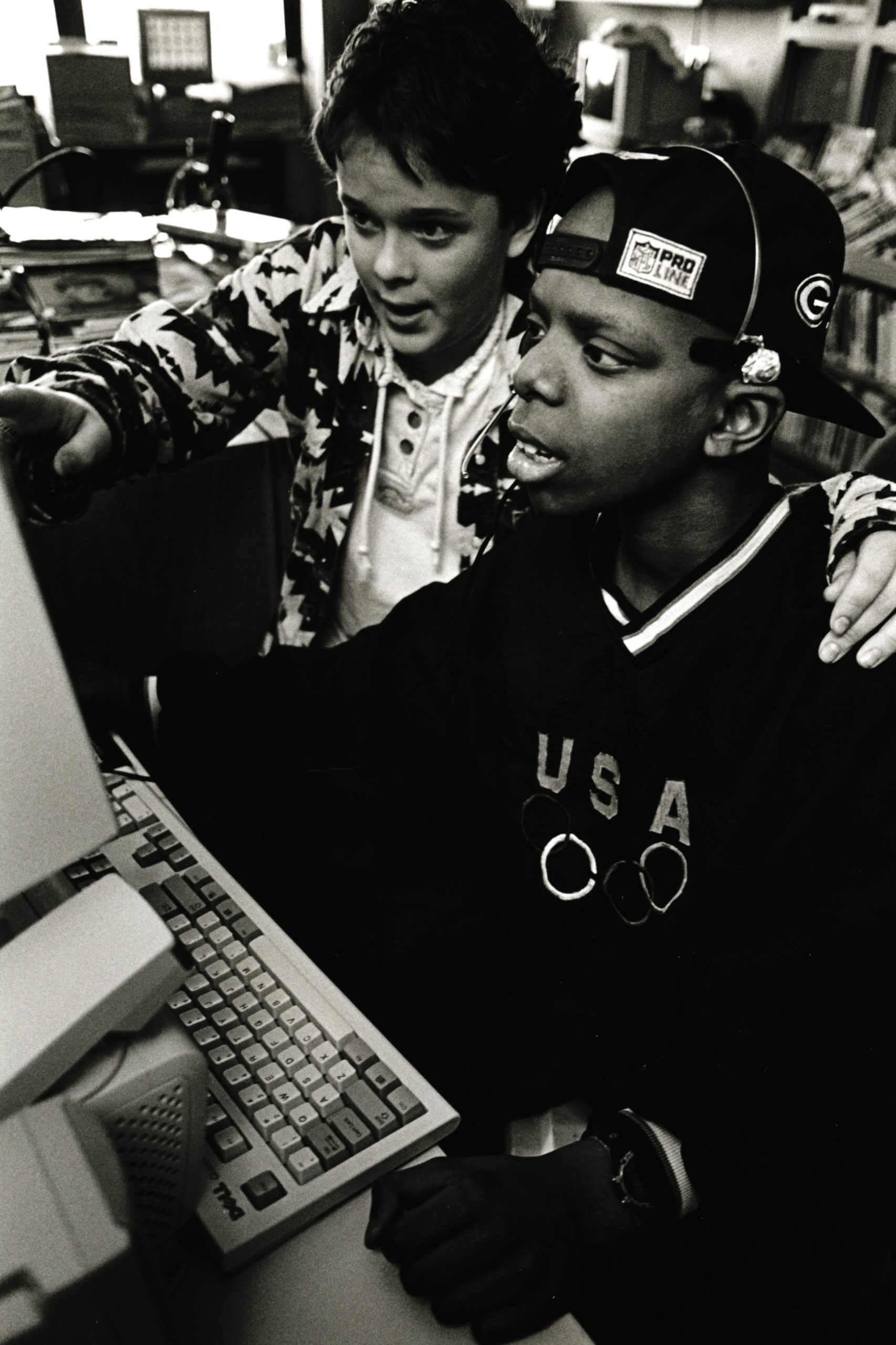
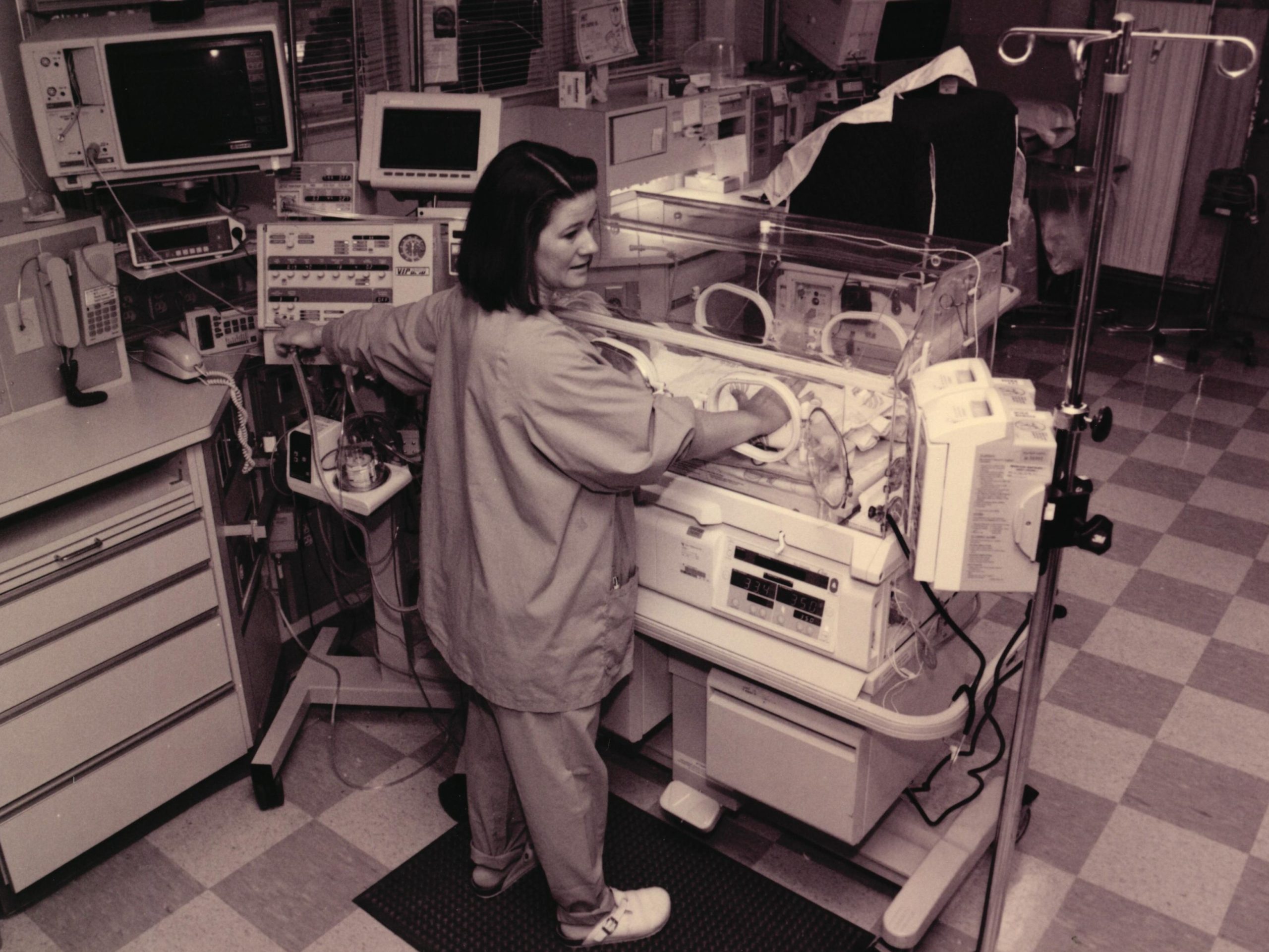
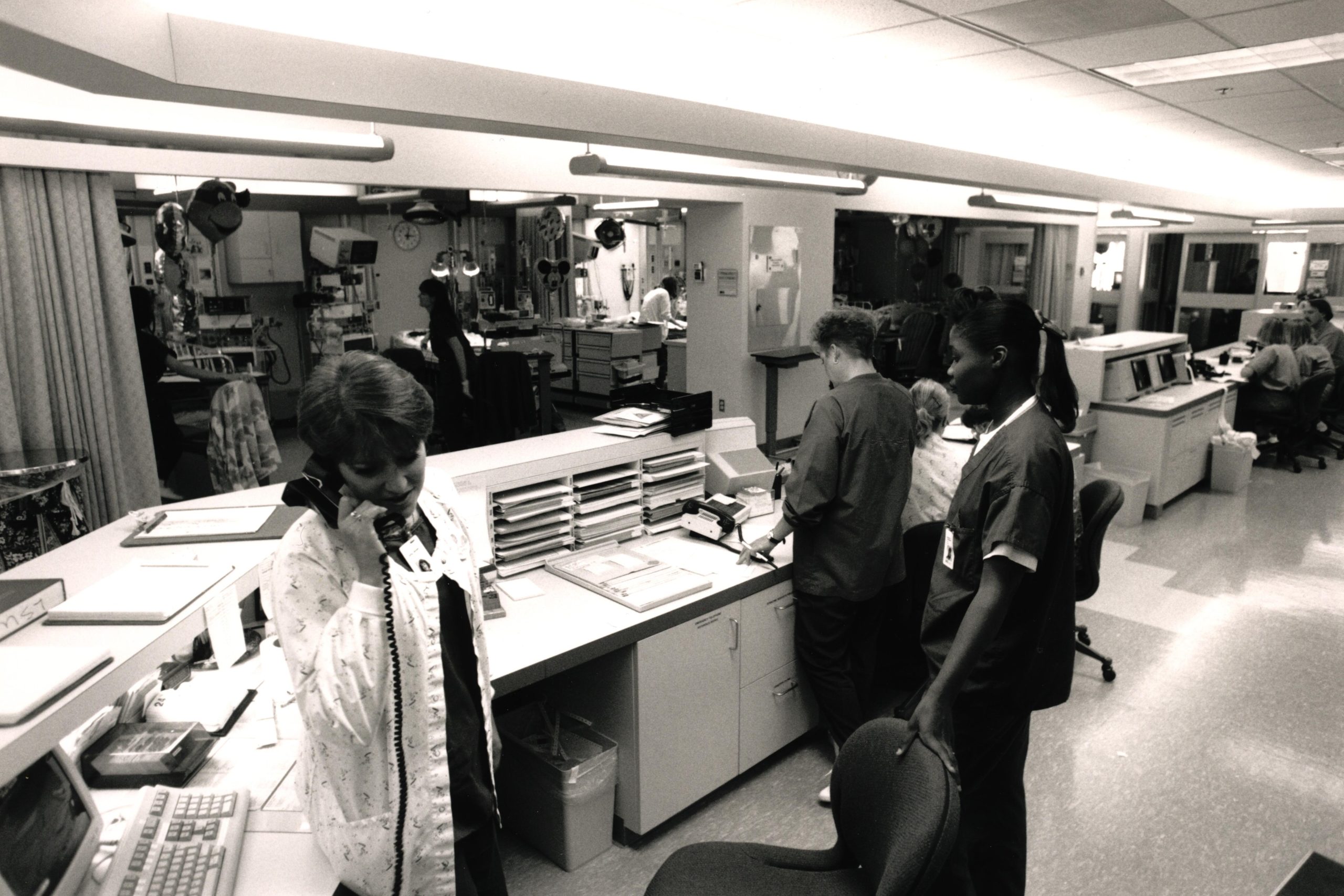
The mid ’90s saw the beginning of another big shift at Children’s Minnesota, and health care in general: the emergence of the Electronic Health Record (EHR). It started as a “pilot project” in the Children’s-St. Paul NICU in 1995 where staff started using “a computerized medical record system” to enter and retrieve a patient’s vital signs, test results and other information.
Patsy Stinchfield remembers what the transition was like.
“We were computer and paper for the longest time. And then it was more computer, but some people just didn’t want to give up their paper charts. Eventually, we had to go cold turkey; no more paper,” Patsy said.
Photos from the Children’s Minnesota archives, circa 1990s (click to enlarge)
Stay tuned to our From the Archives blogs! Next month will feature Children’s Minnesota in the 2000s.
Celebrating a century of care: Children’s Minnesota turns 100
Children’s Minnesota has been here for 100 years. And it’s all because of you: the people who bring their kids here, the ones who work here, the partners who refer their young patients for specialty treatment, the donors who support us, and the community who rallies around the families in our hospitals. Join us in celebrating a century of care — and a bright, healthy future for Minnesota kids.