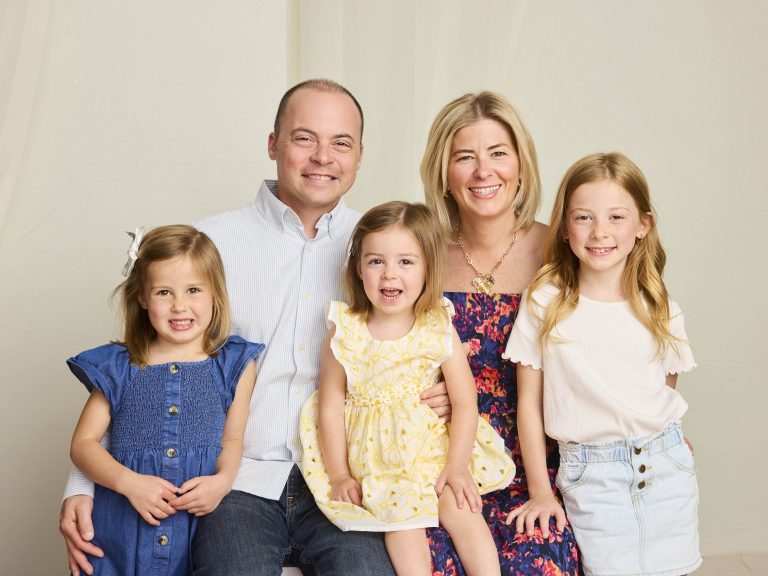

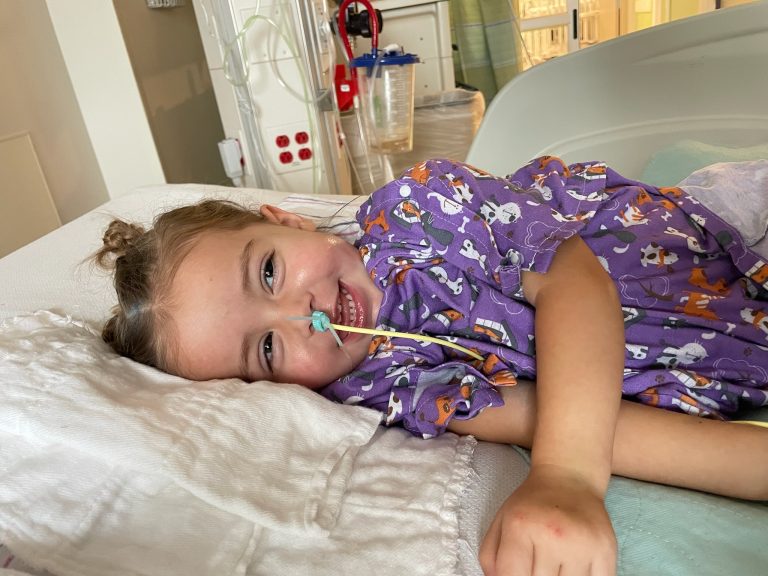
When your child gets a cold, you expect they’ll probably have a runny nose, cough and maybe sneeze sometimes. You don’t expect to find them in bed one morning limp and unresponsive. Unfortunately, that’s how Britta and Ross found their then 2-year-old daughter Sydney in November 2024.
Symptoms and diagnosis of rare brain condition
Sydney had been showing signs of a slight cold for about a week. But when Britta went to check on her that morning in November, she knew something was wrong the moment she turned on the lights.
“She didn’t sit up. She was very lethargic. It was clear she was very sick,” she described.
The family rushed her to urgent care. The staff quickly called an ambulance to take Sydney to the Children’s Minnesota hospital in Minneapolis. When they arrived, the care team ran a series of tests, including a CT scan, an MRI, a spinal tap and an electroencephalogram (EEG).
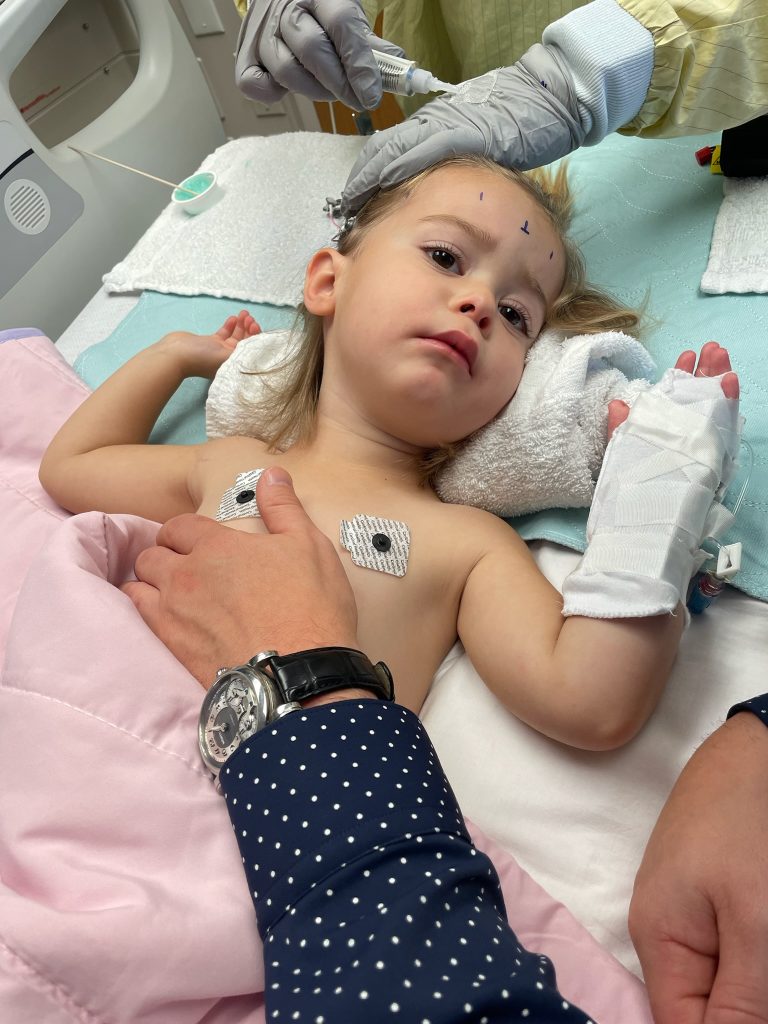
Results showed she had a very rare case of cerebellitis, which is an inflammatory condition that affects the cerebellum, a part of the brain responsible for coordination and balance. That’s why she wasn’t moving or responding. The care team suspected it was caused by a combination of common cold viruses in her body at the same time and her brain just reacted.
Britta and Ross remembered the care team telling them the odds of this happening to their daughter were, “probably one in a million.”
As a result of the cerebellitis, Sydney’s cerebellum swelled, blocking the flow of fluid in her brain. As the fluid built up, it put pressure on her brain, a condition known as hydrocephalus.
Emergency brain surgery
Sydney’s condition was serious. She was moved to the pediatric intensive care unit (PICU) so she could be closely monitored. The hope was the brain swelling would eventually peak and begin to go down over five days. But on the fifth day, in the middle of the night, her breathing stopped. The care team rushed in, put in a breathing tube and told the family she needed emergency brain surgery.
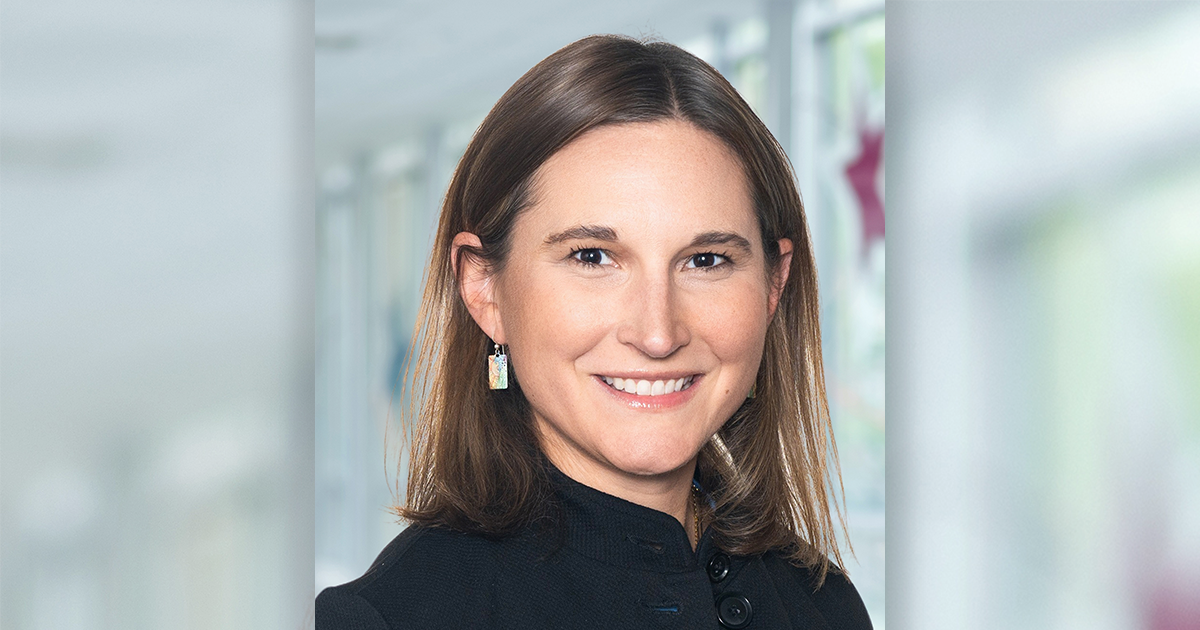
During the emergency surgery, Kyle Halvorson, MD, pediatric neurosurgeon at Children’s Minnesota, put a device in Sydney’s skull to help drain the fluid that was building up. He also did a procedure to relieve pressure on the cerebellum and spinal cord.
“The first thing Dr. Halvorson told us after surgery was, ‘Everything went as planned.’ I began crying and hugging him. So many people saved her life,” said Britta.
And after being up all night, Britta and Ross fell asleep for a couple hours. They were woken up by the care team. Sydney needed another brain surgery.
“I just felt like my heart had been shattered and put back together so many times during all this,” Britta described. “You just keep digging for strength.”
Second brain surgery then slow recovery
The neurosurgery team explained that Sydney needed more invasive brain surgery because there was still a lot of fluid and swelling in her brain. The second brain surgery was with Meysam Kebriaei, MD, medical director of neurosurgery at Children’s Minnesota. During the second brain surgery, the drain in Sydney’s skull was adjusted to better release the extra fluid. The protective covering of her brain was also opened, and a small part of her cerebellum was removed.
After the second brain surgery, everything suggested Sydney had a great chance to get back to being the bubbly little girl her family loved. However, her road to get there was going to be slow.
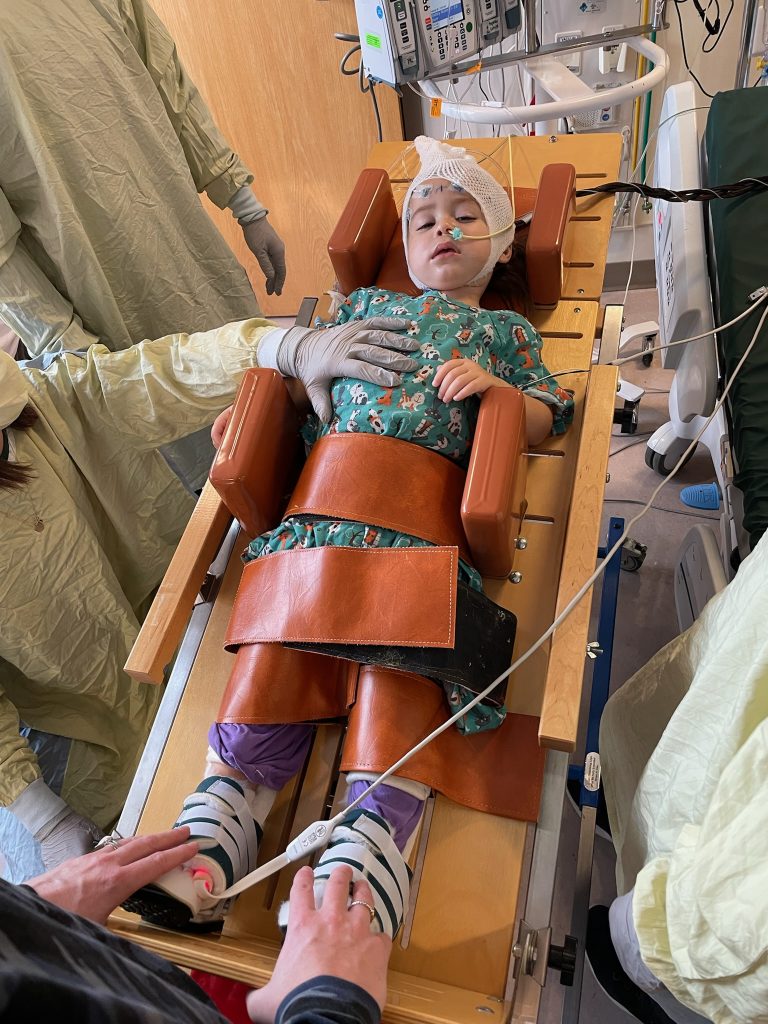
Sydney spent the next four weeks in the PICU. Day by day she slowly got better. Her eye movements became more natural. After a week she gave a big smile. Eventually she was responding to requests to move her fingers and toes.
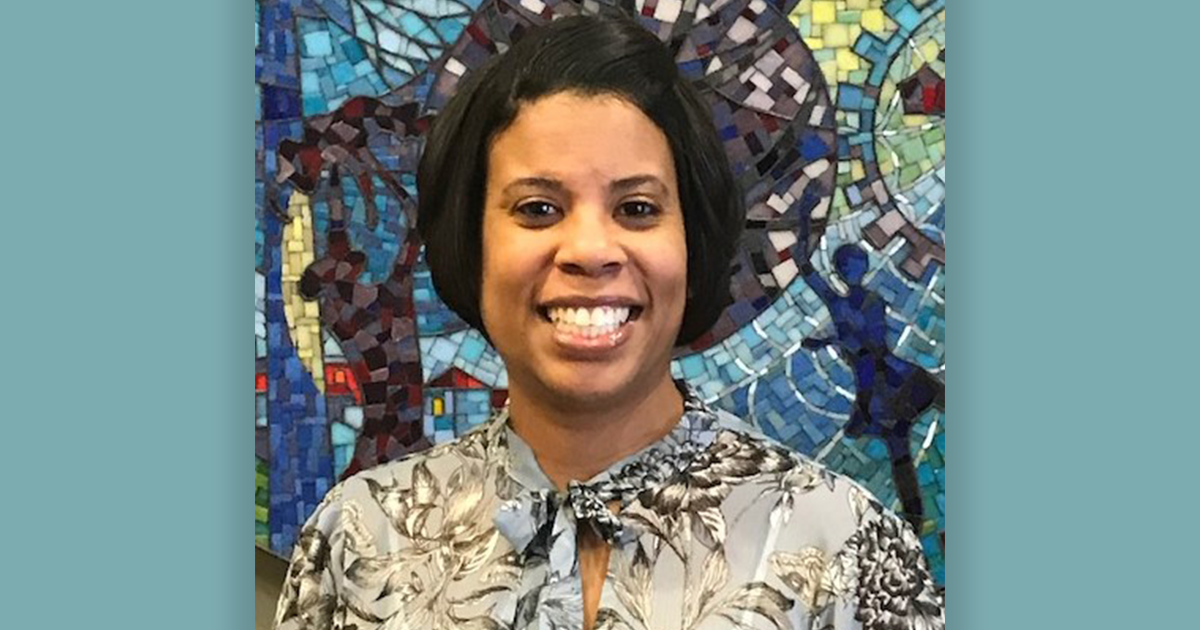
“This condition is incredibly rare, and not all patients survive,” said Dr. Kebriaei. “Our neurosurgery team, along with the teams from PICU, neurology, infectious disease, rehabilitation and so many others, joined together to do everything we knew how to care for Sydney and get her on the path to recovery. She is a very resilient girl.”
Rehabilitation for the effects of cerebellitis
While Sydney was getting better, the cerebellitis left her with significant challenges. She lost so much muscle tone she couldn’t hold her head up. She didn’t know how to swallow, had speech issues and needed help doing almost anything. The team at Children’s Minnesota recommended she go to the inpatient rehabilitation program at Gillette Children’s.
In mid-December, Sydney moved to Gillette Children’s where she received about two months of rehabilitation including daily physical therapy (PT), occupational therapy (OT), and speech therapy. She continues her PT and OT as an outpatient at the Children’s Minnesota rehabilitation clinic in Minnetonka. Her progress has been impressive. She’s once again walking, talking, running and trying to keep up with her two big sisters.
A family's gratitude
As Sydney continues to recover, the family is thankful for the team of experts who cared for her every step of the way.
“Truly how incredibly talented and collaborative the team was at Children’s [Minnesota] and how they worked together to come up with her next steps. It consistently exceeded our expectations,” said Britta. “That was the one thing that struck us the most was all of the different areas of deep expertise and how they really came together.”