

What is craniosynostosis?
Craniosynostosis is a rare birth condition that occurs in about three to five out of every 10,000 live births. It happens when one or more of the cranial sutures—the seams between the bones of the skull—close too early. Early suture closure can affect how the skull and facial bones grow, leading to an abnormal head shape. In some cases, if left untreated, craniosynostosis can result in increased pressure inside the skull.
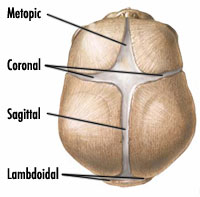
A normal newborn skull is composed of the frontal, parietal, temporal, sphenoid and occipital bones. Having these gaps (described as open sutures) allows for continuous separation of the skull bones during fetal brain growth and allows for molding of the head to facilitate passage through the birth canal.
After birth, these open sutures also allow for continued growth and expansion of the head during the first few years of life. Head growth is driven by growth of the brain. If these sutures close prematurely growth of the skull is restricted in one or more directions. The skull attempts to compensate for this and has an altered growth pattern which leads to a significant deformity of the skull.
What are the different types of craniosynostosis?
Sagittal synostosis
Scaphocephaly, also known as sagittal synostosis, occurs when the sagittal suture—the seam that runs down the middle of the skull from front to back—closes too early. Because side‑to‑side growth is limited, the head grows longer from front to back, creating a long, narrow head shape. A ridge may be felt along the suture, and the soft spot may be small or closed. This is the most common type of craniosynostosis and occurs in about 1 in 2,000 births.
Unicoronal synostosis
Unicoronal synostosis happens when one coronal suture—the seam that runs from the ear to the soft spot on top of the head—closes too early. It most often affects the left side and may be associated with a genetic condition in some cases. This early closure can cause uneven growth of the forehead and brow, with flattening on the affected side. The eye on that side may appear more open, and the nose may angle slightly toward the affected side of the face.
Bicoronal synostosis
Bicoronal synostosis occurs when both coronal sutures close too early. This limits forward growth of the skull and causes the head to grow wider instead. As a result, the head may appear short and wide, with a flat back of the head and a forehead that looks taller or more steeply sloped.
Metopic synostosis
Metopic synostosis occurs when the metopic suture—the seam that runs from the top of the head down the middle of the forehead to the nose—closes too early, usually before birth. This can cause the forehead to appear triangular when viewed from above, with a ridge or prominence in the middle and eyes that may look closer together. The metopic suture normally closes between 6 and 8 months of age, and slightly early closure may cause only a small ridge without changes to head shape, which is often managed with observation.
Lambdoid synostosis
Posterior plagiocephaly occurs when one or both lambdoid sutures—the seams at the back of the skull—close too early. This is the rarest form of non‑syndromic craniosynostosis. It can cause flattening on the back of the head on the affected side, giving the head a trapezoid shape. The ear on that side may sit farther back or lower than the other ear, and there may be fullness on the opposite side of the back of the head.
Multiple suture craniosynostosis
Multiple suture craniosynostosis occurs when more than one skull suture closes too early. One form, called oxycephaly or turricephaly, can cause the head to grow upward. Another very rare form, cloverleaf skull, happens when most cranial sutures close prematurely, giving the skull a cloverleaf appearance. These conditions are uncommon and require specialized evaluation and care.
Minor suture synostosis
Minor suture synostosis is a rare condition involving early closure of smaller sutures near the base of the skull while the major sutures remain open. This can lead to gradual and uneven changes in head shape over time. Children are monitored closely, and surgery may be considered if there are concerns about restricted skull growth, brain development, or increased pressure inside the skull.
What causes craniosynostosis?
The exact cause of craniosynostosis is not fully understood. In some cases, it may be related to genetic factors or associated with rare syndromes such as Apert or Crouzon syndrome. In other cases, the early fusion of a skull suture may be due to differences in the suture itself or the tissue covering the brain (the dura), which can influence how the skull grows. Many cases occur without a clearly identifiable cause.
How is craniosynostosis treated?
Surgery may be recommended to treat craniosynostosis when intervention is needed to support healthy skull and brain development. Indications for surgical treatment may include:
- Prevention of elevated intracranial pressure that can occur in some patients with uncorrected craniosynostosis.
- Prevention of progression of the skull deformity.
- Prevention of progression of the facial deformity.
- Optimization of growth potential of the brain.
Where to find craniosynostosis treatment
Craniosynostosis treatment is provided by our ENT and facial plastic surgery team at Children’s Minnesota. We offer a multidisciplinary craniosynostosis clinic, to help simple to complex cases. To schedule a consultation, please call: 612-874-1292.
Questions?
This information is not specific to your child and provides general information. If you have any questions, please call your nearest Children’s Minensota ENT and facial plastic surgery clinic.