
Simple to complex craniofacial issues
The cleft and craniofacial clinic at Children’s Minnesota welcomes babies, children, teens and even young adults with simple to complex conditions, including:
Craniosynostosis
Craniosynostosis is a premature fusion of the bones of an infant’s skull. Learn more about craniosynostosis treatment.
Facial asymmetry
Facial asymmetry are features on a child’s face that are out of balance.
Mandibular distraction
Mandibular distraction is a method used to increase the length of the jaw bone. It requires a surgical procedure to attach the distractors, on each side of the jaw bone.
Oculoauriculovertebral (OAV) syndrome
Oculoauriculovertebral (OAV) syndrome is a condition that affects the head, neck and spine. Many children with OAV also have microtia. Learn more about microtia here.
Robin sequence
The Robin sequence is a condition that involves the lower jaw and a cleft palate. Learn more about jaw distraction here.
Plagiocephaly
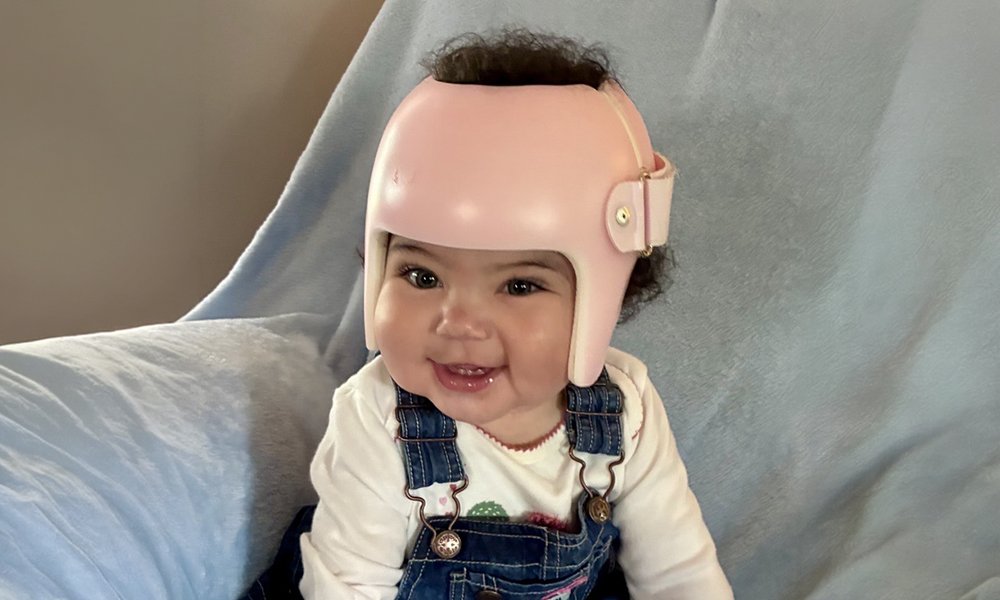
Plagiocephaly, or abnormal head shape. Learn more about plagiocephaly treatment.
Submucous cleft palate
Submucous cleft palate, is a type of cleft palate.
Torticollis
Torticollis is a neck deformity. Learn more about torticollis.
Treacher Collins syndrome
Treacher Collins syndrome is a condition that affects facial bones and tissues.
22q11.2 deletion/ Velocardiofacial Syndrome/ DiGeorge Syndrome
22q11.2 deletion/ Velocardiofacial Syndrome/ DiGeorge Syndrome, a complex condition that may include cleft palate, heart defects and distinct facial features and appearance.
Other conditions that impact cleft development.
Specialized craniofacial treatment
- Surgical repair of cleft lip and cleft palate
- Longitudinal dental and orthodontic consultation for management of complex dental issues that often accompany cleft and craniofacial conditions
- Jaw (orthognathic) surgery if needed
- Specialized speech and language evaluation and treatment
- Psychosocial support services
- Audiology evaluation and hearing aid fitting and programming when needed
- Facial plastic and craniofacial surgery
Our plagiocephaly clinic
Children’s Minnesota offers a comprehensive, multidisciplinary Plagiocephaly Clinic to evaluate and treat infants when there is concern regarding head shape.
Plagiocephaly refers to the flattening of a baby’s head, and can be influenced by time spent lying on the back as well as weakness in the neck muscles. Children with plagiocephaly may benefit from physical therapy to strengthen the neck.
Early recognition is important so parent education and treatment can be initiated. We stress tummy time and decreased pressure on the head by placing the infant on the tummy as often as possible while awake.
Occasionally, an infant’s skull is significantly misshapen and does not respond to these conservative measures. In this case, the child may benefit from evaluation at our Plagiocephaly Clinic to determine additional treatment options.
Infants are evaluated in our Plagiocephaly Clinic as soon as abnormal head shape is identified. During this evaluation, the head is carefully measured and compared to established normal measurements. Our physical therapist also conducts a formal and thorough evaluation of neck range of motion and neck strength. Surgical treatment is rarely recommended by our plagiocephaly team. We work closely with families to meet their goals through therapy and helmeting when appropriate.
The Plagiocephaly Clinic is offered at three locations: Minneapolis, Minnetonka, and St. Paul campuses.
Our craniosynostosis clinic
Children’s Minnesota offers a comprehensive, multidisciplinary Craniosynostosis Clinic, which is designed to care for infants and children with craniosynostosis, including both complex syndromic cases and more straightforward single‑suture cases.
We offer full‑service care, including physical therapy, open cranial vault remodel and cranioplasty surgery, endoscopic minimally invasive repair of craniosynostosis, and helmet molding therapy when indicated. Our multidisciplinary approach allows us to develop an individualized treatment plan for each child.
We follow children over the course of their childhood into adolescence and closely monitor growth and development. We are able to provide families with assistance in obtaining any necessary referrals and services to optimize each child’s neurologic well-being.
Our craniosynostosis team is engaged in research on minimally invasive techniques and reducing surgical blood loss and transfusions during cranial vault remodel surgery. In addition, we are currently studying the long-term neurologic and cognitive development of children with craniosynostosis.
The Craniosynostosis Clinic is offered at our St. Paul and Minneapolis locations.