
The Friese family of five loves being outside. In Moorhead, Minnesota, where they live, they love to go for walks and to go to the park. Chris and Alex have three children, Gabriel, Carlisle and Jasper. They have a dog named Daisy and a cat named Pip Squeak.
After an uneventful first pregnancy, Alex had no reason to believe her second would be any different. But in 2022 when Alex was pregnant with Carlisle, the family received a surprising diagnosis. They found out Carlisle had spina bifida, a condition that occurs when a baby’s spine doesn’t form normally.
The diagnosis
Alex and Chris live in Moorhead where they received prenatal care through Sanford Health in Fargo. In 2020, Alex was diagnosed with Sjögren’s syndrome (SSA) and lupus. As part of this diagnosis, Alex needed to have fetal heart block checks starting at 16 weeks. At the first appointment, everything checked out.
But at the 17-week appointment, their doctor noticed something irregular. After talking with Peter Van Eerden, MD, a specialist in maternal fetal medicine at Sanford Health in Fargo, they ordered more tests. It was then Alex and Chris found out their baby had spina bifida.
Alex and Chris were quickly referred to the Midwest Fetal Care Center (MWFCC) to get the expert help they needed to learn more about this diagnosis and what it would mean for their family. The MWFCC brings together a multi-disciplinary team of highly trained maternal-fetal medicine experts from Allina Health and pediatric and neonatal specialists from Children’s Minnesota.
Surgery at the Midwest Fetal Care Center
At the MWFCC, Alex and Chris met with multiple MWFCC maternal-fetal experts, including Saul Snowise, MD, Joseph Lillegard, MD, PhD, and Clifton Brock, MD, who explained what could be done to treat their baby’s condition. They described a prenatal surgery called the myelomeningocele (MMC) in-utero repair, in which the MWFCC experts would perform surgery to close the spine and stop the injury to the exposed nerves. Plus, Alex and Chris were told this surgery could also be done fetoscopically, meaning the repair could be done with a less-invasive technique which reduces the risks.
“We were excited and nervous,” Alex said. “Our goal was and is to give our baby the best possible life we can.”
The surgery took place on Tuesday, October 25, 2022, which also happened to be World Spina Bifida and Hydrocephalus Day. The team at MWFCC was able to successfully complete the delicate repair through three precise 5-millimeter incisions in the uterus using a small camera, known as a fetoscope, and laparoscopic instruments. “I was nervous before but relieved when it was done and Carlisle was still inside,” said Alex.
Carlisle’s birth
Alex and her baby recovered from surgery well. Based on her care team’s advice, she stayed in the Minneapolis accommodations provided by MWFCC while she recovered. Six days after surgery and still in Minneapolis, Alex had her first follow-up appointment and everything looked good.
One day after her follow-up appointment, Alex woke up feeling sick. She was tired and started to have some cramping. After things didn’t get better, she was told to come in to The Mother Baby Center, another partnership between Allina Health and Children’s Minnesota, where she would be admitted until she gave birth. Alex called her husband to come back down to Minneapolis.
A week after surgery, on November 2, Alex started to have contractions and her care team prepared for birth. “I immediately started crying. I asked if the NICU was ready,” said Alex. “The doctor reassured me that they would be ready.”
Later that night, Carlisle was born. He weighed 1 pound, 14 ounces.
Expert care at Children’s Minnesota
After being born, Carlisle was admitted to Children’s Minnesota for additional care. Because The Mother Baby Center brings together maternal and neonatal experts all in one place, the care continued seamlessly.
Carlisle was first brought to the neonatal intensive care unit (NICU) at Children’s Minnesota and then moved to the infant care center (ICC) for the rest of the time. Children’s Minnesota would be his home for 78 days.
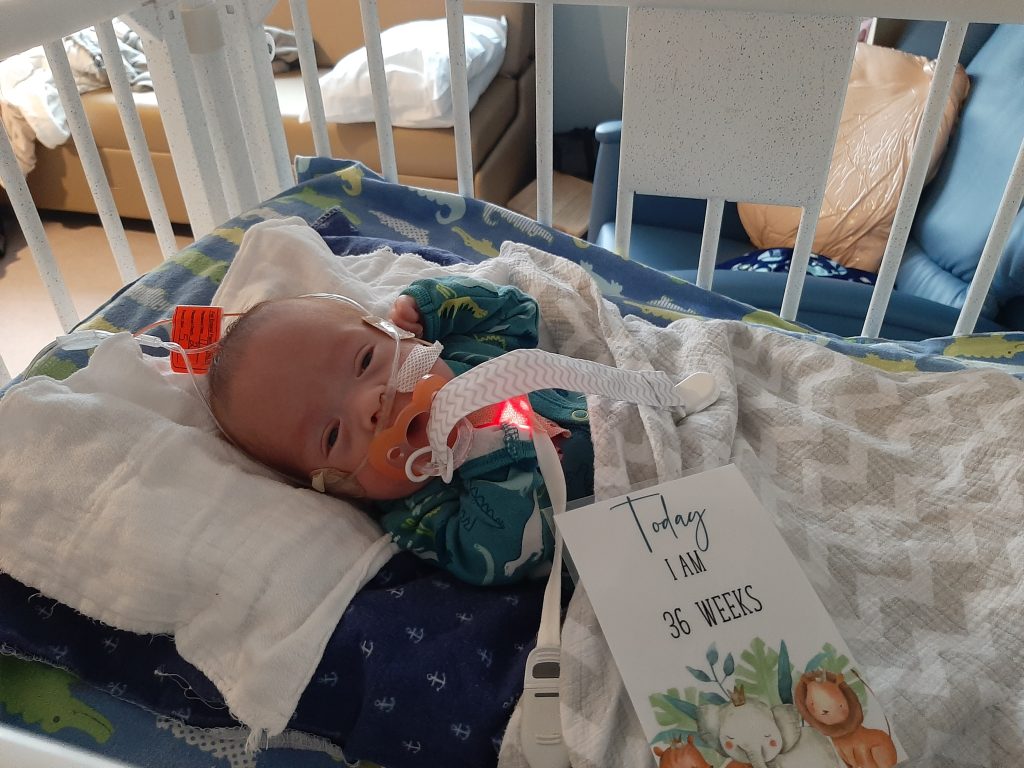
While it was a complicated time for their family with the long drive back home to Moorhead, Alex and Chris were grateful for the expert care they received from their entire care team.
“His team of doctors and nurses were fantastic,” said Alex. They also bonded with their occupational therapists, physical therapists and child life specialists.
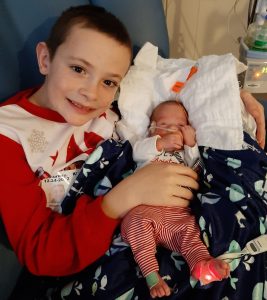
Alex remembers a pivotal moment in their time at Children’s Minnesota. “On Christmas Eve, Gabriel was finally able to hold his baby brother. This is another moment I cherished.”
Carlisle goes home
After 78 days at Children’s Minnesota, Carlisle was ready to go home. “I called Chris and told him to bring Gabriel because Carlisle and I were coming home,” Alex remembers. “We packed both cars full. We put Carlisle, who was still on oxygen, into his car seat and left for home.”
The Friese family is thankful for the well-rounded care they received that helped bring Carlisle home. “The Midwest Fetal Care Center has impacted our journey in ways we never thought possible,” said Alex. “The expertise and compassion the medical team showed still blows me away. From diagnosis day to my postpartum care, we felt so supported and cared for.”

Continued care
Today, Carlisle is 2 years old, he’s crawling and pulling to stand. They have a stander, a wheelchair and a gait trainer for him. “He says a couple of words and mostly uses sign language to communicate. He is such an easy-going, gentle soul,” describes Alex. “He has an amazing personality and the best belly laugh. Everyone who encounters him just loves him.”
Without the MMC repair, Carlisle had a significantly increased risk of needing a shunt in his brain to prevent the build-up of excess fluid, which is a condition called hydrocephalus. He also would likely have had worsened leg, bowel and bladder function.
Because of the MMC repair, Carlisle remains shunt-free up to this point. He receives continued care from Children’s Minnesota. The family brings Carlisle in to the neurosurgery team for check-ups about every six months, he also sees the pulmonology and urology teams as well.
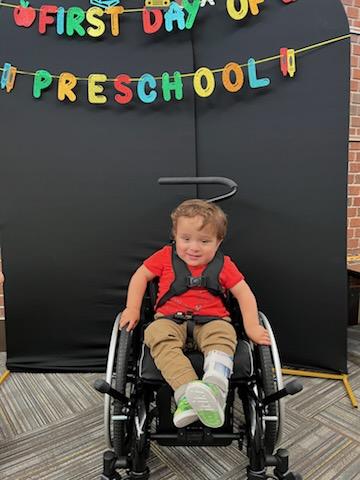
“The Midwest Fetal Care Center and Children’s Minnesota have had an incredible impact our lives,” said Alex. “We are confident in the decisions we have made for Carlisle to give him the best life. We are so incredibly thankful and grateful to everyone who has participated in mine and Carlisle’s care to give him the best life possible.”