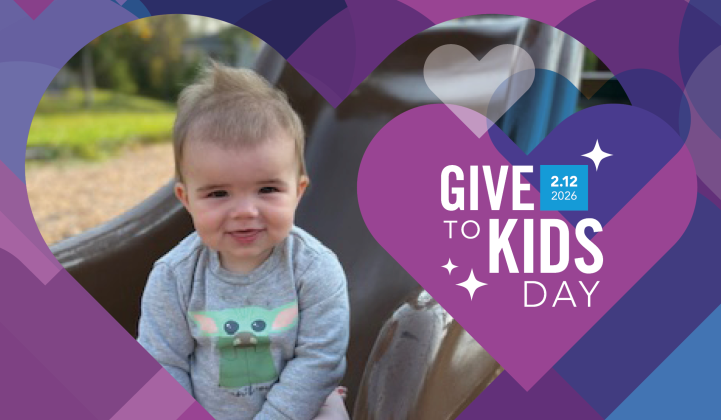

After a prenatal diagnosis of hypoplastic right heart syndrome, Archer Boman and his family continue to face each challenge one day at a time with support from the Children's Minnesota cardiovascular team.
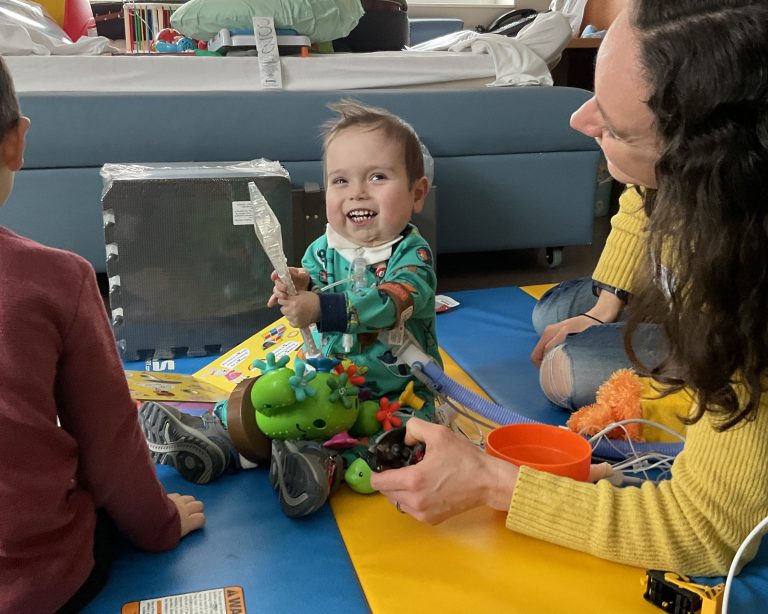
Ashley and Peter Boman, a family from Boone, Iowa, first learned something wasn’t right with their baby’s heart at the 20-week anatomy scan. The ultrasound technician in nearby Ames could not get a clear image of the heart. Soon after, Ashely’s OB/GYN told the couple they couldn’t get a clear image because part of their baby’s heart had not developed normally.
The family had to take in a lot of new information quickly. They also had to decide where their third child, who would be named Archer, should receive care — and who they trusted to guide them through it. They’d have to navigate their journey while also trying to maintain a sense of normalcy for their two other children at home.
Finding answers and the right care team
After the anatomy scan, Ashley was referred to a specialist in Des Moines for an echocardiogram — or echo — which is a moving image of the heart. At first, it was suspected that Archer had hypoplastic left heart syndrome (HLHS) — a serious congenital heart defect where the left side of the heart is underdeveloped.
However, the family was asked if they would like Archer’s scan to be reviewed by any other health systems. They chose Children’s Minnesota and another. Based on what the pediatric cardiovascular team at Children’s Minnesota saw, they encouraged the parents to get a second opinion and suggested a pediatric cardiologist in Des Moines.
The second opinion made a difference. The cardiologist found that Archer actually had hypoplastic right heart syndrome (HRHS), which is an even rarer congenital heart defect than HLHS. In HRHS, the right side of the heart is underdeveloped, but the left side can still help pump blood.
Ashley said the approach of the pediatric cardiovascular team at Children’s Minnesota stood out.
“They called to follow up and make sure we were OK and understood our options,” she said. “I was very thankful for that. My mind was spinning so fast at that point.”
The family had a choice about where their baby would receive care. They chose Children’s Minnesota over a hospital that was closer to home because of how the team communicated and supported them from the start.
Preparing for birth and trusting the plan
Ashley traveled to Minneapolis before delivery so she could stay close to the care team. Being away from her husband and two children was not easy, but she felt it was safest for Archer.
In August 2024, Ashley gave birth at The Mother Baby Center, a partnership between Allina Health and Children’s Minnesota. She was able to hold Archer for a brief time before he needed to go to the cardiovascular intensive care unit (CVICU).
In the first days, the care team focused on helping Ashley understand what was happening.
“As a parent new to navigating having a child with medically complex condition, I appreciated that they explained things in plain, understandable language,” Ashley said.
One moment stands out from those early days. Shortly before Archer’s first heart surgery at 2 days old, the nurses invited Ashley to help give him his first bath.
“It felt special to be able to do something simple and just be his mom,” Ashley said.
A long and challenging road
Archer’s time in the CVICU was filled with constant care and many challenges.
After his first surgery at 2 days old, more procedures and surgeries were needed in the following weeks and months to try and help his heart. A few times, Archer needed to be put on ECMO (extracorporeal membrane oxygenation), a machine that supports the heart and lungs.
At one point, fluid built up in his chest. After draining the fluid, he needed to be on a fat-free diet for three months, meaning no breastmilk. Ashley worked hard to continue providing breastmilk in a way her son could tolerate. With approval from the care team, she bought a centrifuge to process her milk to separate out the fat.
A path home
After many months in the hospital, Ashley and Peter faced a tough decision. They could keep Archer in the hospital longer and hope he could eventually come off breathing support. Or they bring him home to Iowa with a tracheostomy tube and ventilator to help him breathe.
The couple thought honestly about what life at home would look like with a child with medically complex needs.
They also had two other children at home to care for — Connor and Melody — and Peter worked a physically demanding full-time job.
After thinking it over for a week and asking many questions — they chose to bring him home.
But before Archer could go home, Ashley and Peter received a lot of training from the care team. They learned how to care for his tracheostomy tube, ventilator and feeding tube.
After seven and a half months in the hospital, Archer was discharged home.
Life at home
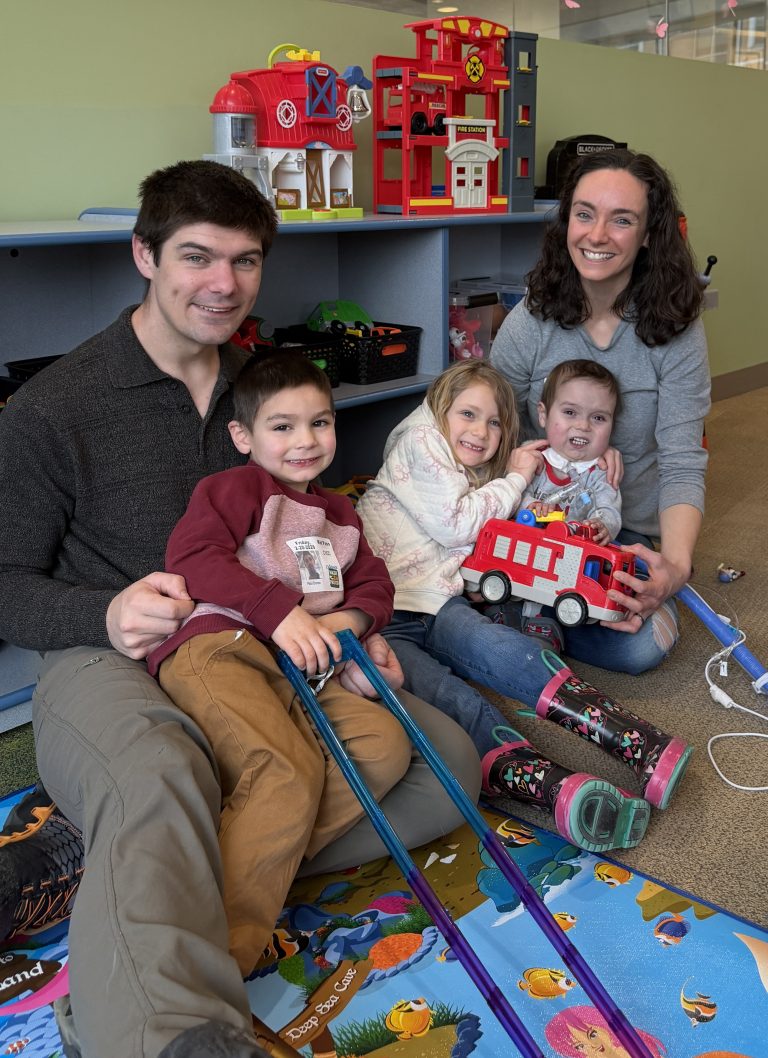
The family was happy to be home together. But the transition was not easy. Within days of leaving the hospital, Archer was back in the emergency room after struggling to breathe. In the weeks that followed, he needed emergency care several more times. He was flown by helicopter to an Iowa hospital twice, including after a cardiac arrest at home that required his parents to perform CPR while they waited for help to arrive.
Despite the setbacks, Archer recovered and eventually returned home with additional nursing support in place.
He made progress too.
After getting the tracheostomy, Ashley noticed Archer became more comfortable and more engaged. He smiled more and showed more interest in people and playing.
“If he knows you, his first request is, ‘play with me,’” Ashley said.
Taking it one day at a time
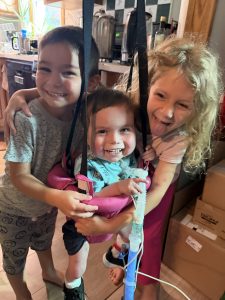
Today, Archer is known by doctors and nurses as the little boy who rides his toy horse around the hospital. He is learning sign language and becoming more independent. Recently, he took his first steps with a walker. It’s a milestone his family once wasn’t sure they would see.
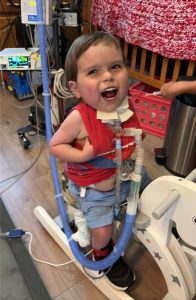
His road ahead is still uncertain.
Recent tests brought encouraging news about Archer’s airway and breathing support. At the same time, his family has learned that his heart still faces serious challenges.
For Ashley and Peter, those conversations are difficult. But after everything Archer has overcome, they have learned to focus on what is in front of them.
“For now, we are living and rejoicing,” Ashley said.