
Children’s Minnesota NICU at Mercy Hospital and St. Paul PICU celebrate CLABSI free milestones
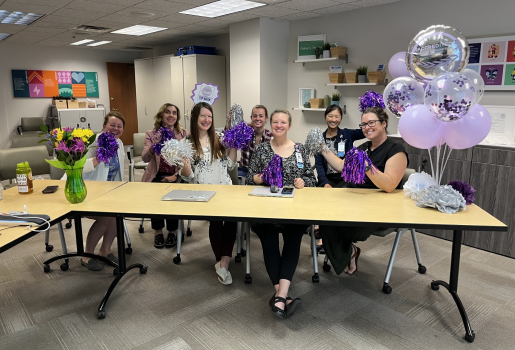
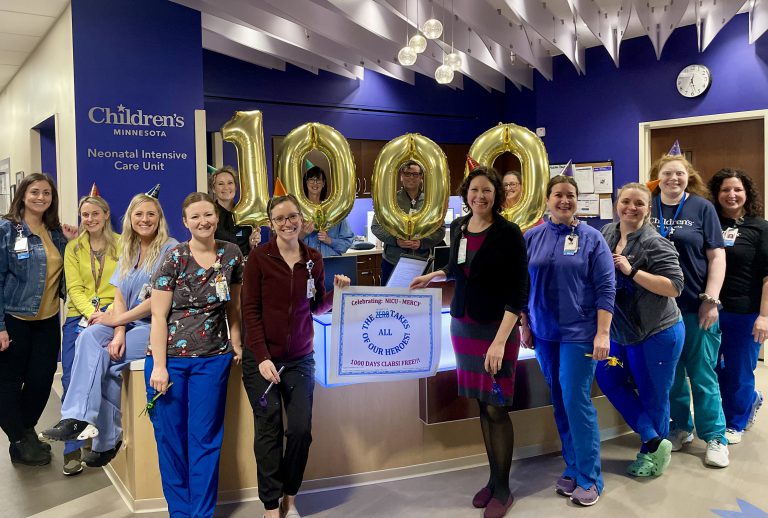
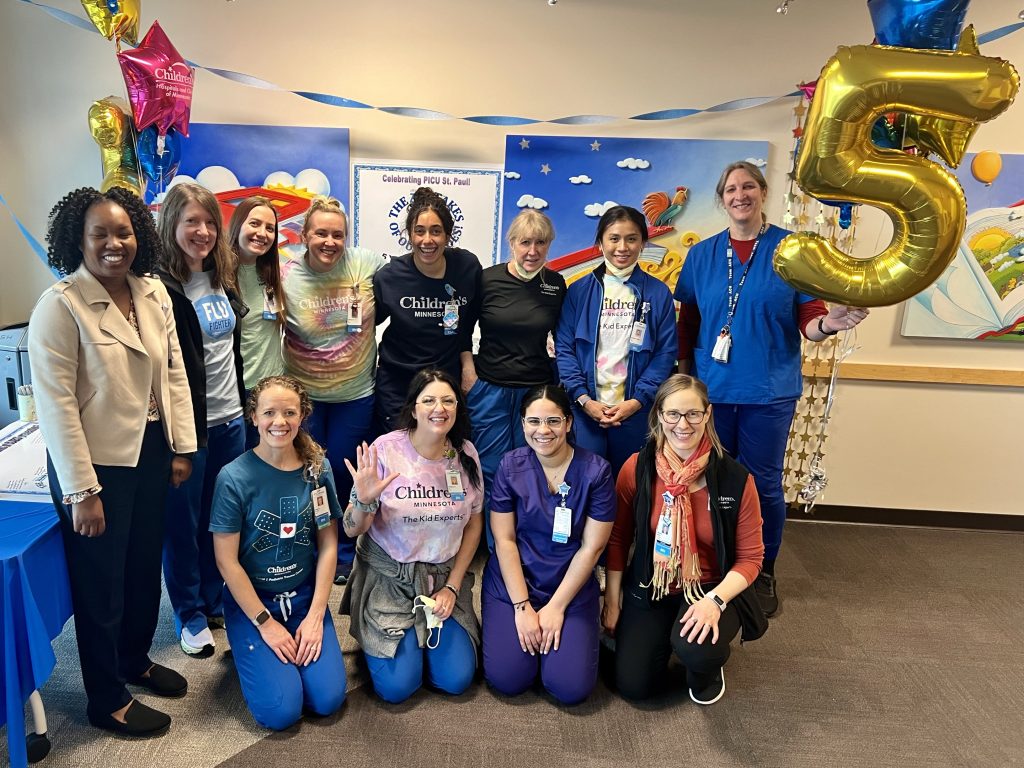
In 2024, the Kid Experts at Children’s Minnesota’s Level III Neonatal Intensive Care Unit (NICU) at Mercy Hospital in Coon Rapids, Minnesota surpassed more than 1,000 days without a CLABSI. Simultaneously, our St. Paul pediatric intensive care unit (PICU) celebrated 5 years without an infection of this kind.
The achievement was possible thanks to collaboration among clinicians, nurses, clinical support associates, environmental services staff and more. Patient safety and infection prevention experts also work closely with staff to provide updated policies and procedures designed to protect all patients from CLABSIs. Some best practices the team follows include:
- Washing hands and/or using alcohol-based hand rub frequently.
- Wearing a mask and sterile gloves when changing the dressing and injection cap(s).
- Assessing the site frequently for signs of infection.
- Daily chlorhexidine (CHG) bath treatment while in the hospital.
- Daily discussion with the care team to see if the central line is still needed.
- Following strict protocols when inserting central lines as recommended by the Centers for Disease Control and Prevention (CDC).
Children’s Minnesota’s goal is to prevent these infections in every way we can. As you can see, our staff do just that.
Kids first: staff exceed 2024 patient safety goals
Patient safety is of the utmost importance to kid experts. When families walk into our hospitals, clinics and specialty sites, they trust us to look after their child, their favorite person in the world, as if they were our own. That’s why we devote plentiful time and resources to ensuring we keep the kids in our care safe.
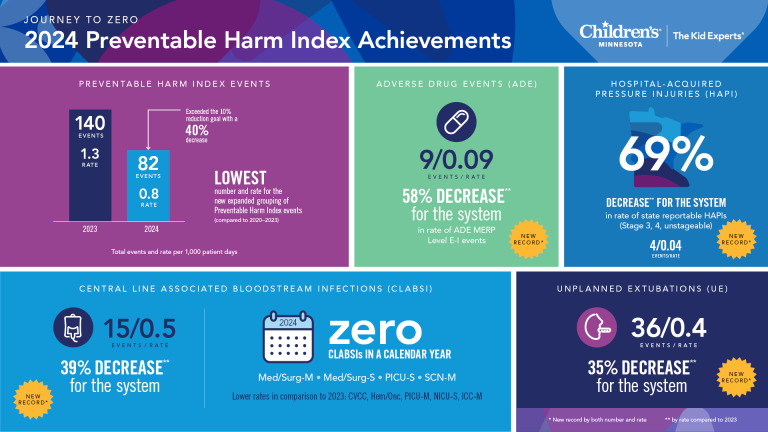
And our hard work pays off! Children’s Minnesota aimed to reduce the 2024 Preventable Harm Index by 10% compared to 2023. We not only met this goal but far surpassed it by achieving a 40% reduction by number and rate. It was one of our safest years yet thanks to the teamwork, collaboration, attention to detail and diligence of each and every staff member.
Be remarkable: 2024 Preventable Harm Index results
Children’s Minnesota set multiple new patient safety records, including:
There were 82 total preventable harm index events with a rate of 0.8 per 1,000 patient days. This is the lowest number and rate for the newly expanded grouping of preventable harm index events, dating back to 2020.
Adverse drug events (ADE) – MERP, level E-I were in the single digits; this is a new milestone and represents a 58% reduction from 2023. This is in part due to improving barcode medication administration scanning rates, updating MedActionPlan, and enhancing insulin safety by developing an insulin calculator and making insulin ordering changes.
Central line associated blood stream infections (CLABSI) were down 39% thanks to expanding the CLABSI Champion program on high-risk units; rounding to proactively identify and address concerns; engaging patients and families; and collaborating across departments.
Stage 3, 4 and unstageable hospital-acquired pressure injuries (HAPI) decreased 69%. The cardiovascular care center and the neonatal units had zero HAPIs in all of 2024. Some key contributors to this accomplishment include the Journey to Zero Champion program, weekly active surveillance on high-risk units and the launch of proactive safety huddles.
Unplanned extubations (UE), one of the most frequent preventable harm events, saw a 35% reduction. This is thanks to a multi-disciplinary team that has been evaluating our data for trends and opportunities, trialing UE prevention bundle observations and coaching, and conducting cause analyses following UE events.
There were zero serious safety events (SSEs) in 2024, setting a record for days without an SSE. We are proud to be featured in the Children’s Hospitals’ Solutions for Patient Safety (SPS) Network SHINE report for our success in this area.
What is the Preventable Harm Index?
The Preventable Harm Index is an aggregated total of preventable harm indicators that includes selected health care associated conditions (HAC) and serious safety events (SSEs). The index serves as an internal comparison measure to gauge performance over time.
- The Preventable Harm Index was expanded in 2024 to include additional event types, including unplanned extubation (UE), peripheral intravenous infiltration and extravasation (PIVIE) with serious harm, and spinal fusion surgical site infection (SSI).

What is Journey to Zero?
Journey to Zero (JTZ) is a multidisciplinary infrastructure focused on reducing preventable harm from health care associated conditions (HACs) and supporting a high reliability safety culture. Children’s Minnesota participates in the Children’s Hospitals’ Solutions for Patient Safety (SPS) Network, a network of over 140 children’s hospitals. The SPS structure and resources guide the JTZ work.
Children’s Minnesota Transition to Practice Program receives re-accreditation with distinction
Children’s Minnesota is pleased to announce that our Transition to Practice (TTP) Program received re-accreditation with distinction from the American Nurses Credentialing Center (ANCC) Practice Transition Accreditation Program (PTAP®). The ANCC PTAP sets the global standard for residency and fellowship programs that transition registered nurses (RNs) to the workforce following undergraduate or graduate studies.
“Receiving the highest level of re-accreditation validates all of the hard work nurses and leaders have done to provide excellent evidence-based education and support for newly licensed nurses as they enter the organization,” said Caroline Njau, chief nursing officer and senior vice president of patient care services. “This program is a win-win. It creates a psychologically safe and rich learning environment for newly licensed nurses and meets the increased organizational need for highly skilled clinicians, meaning we can provide remarkable care to more children and families in our community.”
Increasing cohorts
Starting in 2023, Children’s Minnesota nursing began hosting five Transition to Practice Program cohorts per year. This increase from the standard three cohorts is part of nursing and talent acquisition’s collaboration to fill open positions with skilled nurses as quickly as possible. Each individual cohort has also gotten larger, thanks to the record number of clinical nurse instructors who stepped up to support the program.
Becoming a clinical nurse instructor is a stretch assignment that gives clinical nurses the opportunity to provide education and support to Transition to Practice Program nurses, while also developing their own education and leadership skills.
The program’s retention rates are over 95%, some of the highest in the country. Children’s Minnesota has welcomed over 300 TTP RNs into the organization since receiving accreditation in 2020.
Reaccreditation process
To achieve PTAP accreditation, organizations must pass an extensive application process, including submitting a detailed self-study, giving real-life examples of TTP RNs applying their knowledge and skill at the bedside, conducting a program participant survey and hosting a virtual site visit.
Children’s Minnesota is home to three of the seven sites in Minnesota that are accredited with distinction. This includes Children’s Minnesota Minneapolis and St. Paul Hospitals, as well as The Mother Baby Center at Mercy with Children’s Minnesota. Accreditation is granted for four years.
About the program
The Children’s Minnesota Transition to Practice Program was established in 2012 and accepts applications up to five times a year. The program is designed to provide enhanced support to newly licensed nurses through hybrid classroom and clinical opportunities, including simulations, eLearns, reflections, patient care experiences, and initial precepted clinical shifts.
Children’s Minnesota receives new $1 million cancer research endowment from the Pine Tree Apple Classic Fund
Children’s Minnesota and Pine Tree Apple Classic Fund (PTACF) announced the new Hematology, Oncology Point of Care through Survivorship Research Endowment Fund. The fund supports research by nurses and advanced practice practitioners aimed at addressing any stage of a patient’s care journey with a focus on the unique long-term physical, mental and social challenges patients can face months or years after completing cancer treatment.
“We are grateful to the Pine Tree Apple Classic Fund for this new investment in not only research at Children’s Minnesota, but our nurses and cancer survivorship,” said Caroline Njau, chief nursing officer and senior vice president of patient care services at Children’s Minnesota. “This generous support will give our kid experts the ability to explore new avenues for treatment and care that can improve the lives of children diagnosed with cancer.”
The majority of children diagnosed with cancer will survive into adulthood. However, many of the children, adolescents and young adults considered cured can experience health issues long after completing treatment. Survivorship programs monitor survivors for the late effects of cancer and treatment, address any problems and educate them about their health risks.
Pictured: Julia Gourde, APRN, CNP, CPON, co-director of cancer survivorship, received some of the endowment’s funding to examine the factors that preserve bone health and function during and after leukemia treatment.
About Pine Tree Apple Tennis Classic
The Pine Tree Apple Tennis Classic was created in 1986 by Ron and Mary Ann Peterson when their 12-year-old daughter Julieann was diagnosed with leukemia. Julieann was treated at Children’s Minnesota and survived. Grateful for the care their daughter received at Children’s Minnesota, the Petersons established the mixed doubles tennis tournament with a mission to raise funds and support research to lessen the suffering caused by pediatric cancer. The Jacobson family of the Pine Tree Apple Orchard stepped in to provide the funds to establish the event.
Meet Nicole Beckmann, Children’s Minnesota’s nurse scientist
Meet Nicole Beckmann, PhD, APRN, CPNP-PC, a dedicated nurse scientist leading the life-changing research made possible by Pine Tree Apple Classic Fund’s (PTACF) new Hematology, Oncology Point of Care through Survivorship Research Endowment.
At just 16 years old, Nicole began her career as a nursing assistant in a long-term care unit. At 18, she took her talents to a rural hospital setting. “During the evening, overnight, and weekend hours, the nurses were the only health providers in the building. They were fearless leaders, skilled clinicians and could meet any challenge that walked through the door,” Nicole described. “I was in awe of their versatility, calm amid chaos and the genuine care they put into each patient’s experience. I was hooked!”
After receiving her bachelor’s and master’s degrees, she went on to hold nurse practitioner roles in urology, hospital medicine and the special care nursery. Up next was a PhD program in nurse science, where she combined her passions for clinical research and patient care delivery.
Currently, she serves as the nurse scientist at Children’s Minnesota, a role in which she mentors nurses and advanced practice providers as they pursue innovative quality improvement projects and research studies. In this role, Nicole and the health care professionals she’s empowered have made significant contributions to improving the patient experience, mitigating treatment side effects and supporting families every step of the way.
Nicole will lead the implementation of endowment funds and support the research of nurses and advanced practice providers across the organization. Their research will focus on topics like minimizing symptom distress during pediatric oncology treatment; management of disease and treatment toxicities; and improving the cancer care experience for patients and their families, from diagnosis and treatment into survivorship. It will also enable nurses to explore innovative solutions to practice problems they encounter caring for children with cancer.
Nicole’s first experience with this patient population was as a nurse practitioner in a pediatric blood and marrow transplant program. “I saw how difficult the transplant process was for children and their families and wanted to research how to make it easier,” she shared. “What I found through my initial work is that families felt nurses were an essential support system when their loved ones couldn’t relate to their experiences. I wanted to understand what could be done to better support caregivers of children with life threatening or life limiting illnesses.” This newly funded research will make great strides toward doing just that.
The 2024 Evidence-Based Practice Program cohort moves the needle in a variety of care areas
Children’s Minnesota’s Evidence-Based Practice (EBP) Program is designed to educate nurses and other clinical staff on how new findings are integrated into practice. By utilizing the Iowa Model Revised, participants are guided through the steps of evidence-based practice, including formulating a clinical question, searching for evidence, appraising the evidence, and implementing and evaluating the practice change.
Participants are supported by EBP mentors who provide guidance and resources throughout the process; and ultimately, through the implementation of evidence-based practice changes, staff are able to address current health care challenges and improve patient outcomes.
The 2024 EBP cohort consisted of five project leaders and three Doctor of Nursing Practice (DNP) students, along with mentors for each project leader.
Ana Brown, BSN, RN, CPHON, CCRP, focused on piloting a non-randomized intervention, implementing photobiomodulation therapy for prevention and management of chemotherapy and radiation-induced oral mucositis versus standard mucositis prevention guidelines in pediatric oncology patients in the outpatient clinic environment. Ana worked with DNP student Alyssa Eich.
Jordan Hoffman, RN, VA-BC, focused on reducing the number of painful blood draw procedures by creating a nurse-driven procedure to draw labs from established lines.
Chantise Hunt, MA, MT-BC, NICU-MT, focused on pain management through the lens of music therapy. The purpose of her project was to provide pain management during and immediately following circumcisions in close-to-discharge neonates in the NICU by utilizing the Pacifier Activated Lullaby device paired with current Comfort Promise practices. Chantise worked with DNP student Ah Thao-Vang.
Terry Rawson, RN, focused on pediatric surgery, specifically myringotomy and/or adenoidectomy on the Minneapolis campus. He used a protocol of timed administration of non-narcotic analgesics versus the current practice. The goals of the study were to decrease the post-op pain score, length of stay, postoperative nausea and vomiting, and emergence delirium.
Carllie Wingen, MA, CCLS, focused on creating a nursing protocol to utilize treatment rooms more effectively to help decrease patient fear and distress, and to increase positive reactions while interacting with the health care team. Carllie worked with DNP student Ellen Harvey.
The EBP program is sponsored by the Center for Professional Development and Practice (CPDP) and is promoted by the nurse-led EBP and Research Council.