
Children’s Minnesota expands inclusive patient clothing with introduction of modest hospital gowns
To ensure inclusive and culturally sensitive care, a multidisciplinary team of kid experts joined together with a Minnesota-based company called Henna & Hijabs to create modest pediatric hospital gowns for patients during their hospital stays. The idea was first raised by summer interns who noticed a gap in hospital-issued clothing.
The new modesty gowns, designed by Henna & Hijabs founder Hilal Ibrahim, allow clinical teams to provide care while giving patients modest coverage through intentional design features: the gowns come in four sizes and have 3/4 length sleeves, a detachable hijab component and a closure that can be worn in the front or the back. Though designed with Muslim patients in mind, the gowns are available to all patients.
Children’s Minnesota is proud to be one of the first U.S. hospital systems to offer modesty gowns for kids. The new gowns were first available in March of 2024 on the 6th floor of our Minneapolis hospital. During this pilot phase, project leaders collected feedback from staff and patient families.
Modesty gowns are just the latest example of inclusive and culturally sensitive initiatives at Children’s Minnesota. In summer 2023, we began offering head caps and hijabs to patients. We also offer hair care products made for children with varied hair textures, after receiving input from patient families looking for more inclusive options.
Employees from all corners of Children’s Minnesota brought the modesty gown project to fruition and are continuing to help deliver on our mission to champion the health needs of all kids.
Heidi Shafland, APRN, CNS, helps amplify inclusive patient clothing project
Patients of color have historically experienced disparities across the spectrum of health care, even when it comes to the most basic of needs — hospital-issued clothing. That’s why a multidisciplinary team, including the Black Employee Empowerment Network (BEEN) employee resource group, the Muslim employee resource group (MERG) and the Nurses of Color (NOC) employee resource group, set out to address the issue by expanding and improving our offerings to include head caps and hijabs.When the team asked for help disseminating these changes and additions, Heidi Shafland, APRN, CNS, jumped at the opportunity. Heidi, a clinical nurse specialist in the cardiovascular care center, is no stranger to health equity work. She first dipped her toe into this important area when she fielded a concern from a family about hair care products available for their child during their hospital stay.
Shafland formed a small group, including Courtney Kenefick, BSN, RN, RN-C, clinical nurse specialist, 5th floor St. Paul, and Hani Mohammod, BSN, RN, CCRN, clinical nurse, cardiovascular intensive care unit. The group identified two issues: a lack of knowledge about correctly performing hair care for children with different textured hair and a lack of products provided by Children’s Minnesota to adequately care for the hair of African American patients.
Heidi has described health equity work as a passion that fills her cup and allows her to make a meaningful impact. When the opportunity arose to help provide equitable and inclusive patient clothing, she raised her hand yet again to be involved.
“I have always prided myself on providing the best patient care I could,” said Heidi. “When I learned not all patients experience equitable care, I wanted to do my part to improve the patient experience for all. I understand a lot of these inequities are due to a lack of knowledge, so I am determined to create a safe place to ask questions and learn.”
Heidi describes her role in this project as “standing on the shoulders of equity experts throughout the health system to help amplify this great work.” She has acted as a nurse liaison to educate teams on how they can access and use these more inclusive products and garments.
Children’s Minnesota Student Nurse Internship Program ranked among Best Internships for Diversity by Vault
Our Summer Nurse Internship Program was named among the “Best Internships for Diversity” by Vault! More specifically, the program was ranked #68 for “2025 Best Internships for Diversity with Respect to Women.”
The Student Nurse Internship Program is a full-time, 10-week paid internship for pre-licensure nursing students in the summer between their junior and senior years. Interns are hired into the neonatal, critical care, med/surg, peri-operative, inpatient mental health and ambulatory care areas.
Vault surveyed thousands of current and former interns about their internship programs, asking them to assess their experiences on a variety of factors. Recognizing the importance of a diverse and inclusive environment, Vault has devoted a separate section to interns’ ratings with respect to diversity. The 2025 rankings are based on the results of the internship survey conducted in the summer of 2024.
This accomplishment validates the organization’s hard work to ensure all who engage with Children’s Minnesota feel valued, respected and supported.
Small Baby Committee provides a specialized start for our tiniest patients
“Won’t you be my neighbor?”
This famous phrase was commonly said by the endlessly kind and caring Mister Rogers. For the past 8 years, this sentiment has also been shared with premature babies born in the St. Paul neonatal intensive care unit (NICU). In 2016, the St. Paul NICU team opened what they lovingly call the “Small Baby Neighborhood” to welcome our tiniest, most fragile patients into the world. To be a resident, babies must be born at 28 weeks gestation (or earlier) or weigh 1,000 grams (or less).
Founding the neighborhood
With decades of combined neonatal care experience, Dr. Jill Therien, medical director of the St. Paul NICU, and the NICU nurses saw a need for some TLC for this patient population. The creation of the unit was inspired by published research that showed improvements in patient outcomes with the implementation of a series of guidelines addressing every area of a neonate’s care. Dr. Therien and other neonatologists carefully reviewed the literature and built a roadmap of care, beginning in the delivery room and continuing through the baby’s first several weeks of life.
Intentional care
Using evidence-based practice, founding members determined a need to prioritize neurodevelopment with dimly lit spaces and noise control to simulate the in-utero environment, minimize stress and protect their sleep as they grow bigger and stronger.
Small baby neighborhood nurses focus on two-person care, whether that’s with another nurse, a clinical support associate or the patient’s parent, to provide comfort. This second person helps contain the baby while the other caregiver is doing assessments, diaper changes, repositioning the neonate or providing pain management.
The team also relies on cue-based care rather than a set schedule. This is when the baby shows them, through an increased heart rate, kicking or restlessness, that they are ready for care interventions.
Perhaps most importantly, the small baby team prioritizes helping parents hold their babies soon after birth and as often as possible throughout their stay. The small baby nurses and respiratory therapists are experts at managing the various lines and tubes connected to their patients so parents can comfortably provide skin-to-skin contact with their baby. This practice, also known as “kangaroo care,” has many benefits, including stabilizing breathing and heart rate, improving sleep quality, encouraging weight gain and brain development, reducing pain and infection risk, regulating the baby’s temperature, and increasing parent bonding and confidence.
All of this care is partially made possible because St. Paul NICU leaders were uniquely able to physically cohort these extremely premature babies in a dedicated wing of the unit. The neighborhood layout lends itself to keeping lights and noise to a minimum, staffing nurses in a way where they can support two-person cares and involving parents as much as possible.
Over time, due to retirements and onboarding new team members, the neighborhood lost some of its momentum. During these six years, Children’s Minnesota also experienced significant growth in the neonatologist team, many of whom came from other institutions and brought with them their own experience.
Looking for a way to reinvigorate their efforts and remember their “why,” St. Paul NICU nurses were invited by manager Raina Estrem to a forum in June 2022. A great idea emerged: the Small Baby Committee.
The Small Baby Committee
The Small Baby Committee is nurse driven but includes multi-disciplinary members to provide the full scope of insights on small baby care. The committee currently has ten nurses from all shifts, two clinical educators, a nurse practitioner, a respiratory therapy clinical educator and two neonatologists.
The committee also invites input from NICU leadership, occupational and physical therapy partners, social work and the March of Dimes coordinator to create better pathways to support patients and their families on their long journey in the NICU.
The neonatal research department runs studies in collaboration with neonatologists and provides the committee with evidence-based findings to implement in the care of patients.
The committee’s priorities
Over the past year, neonatologists reviewed and updated the entire catalog of small baby protocols to reflect the most current evidence-based practices. At this time, the committee started accredited “Small Baby Education Days” for the nursing team to learn about the details and rationale behind these protocols and to provide hands-on professional development.
The committee meets quarterly and produces a newsletter playfully titled “Tiny Tidbits” to update staff on small baby care and research. The committee reviews outcomes yearly to ensure they can see the impact of their work. Their work has significantly improved survival rates and decreased major complications associated with prematurity since the Small Baby Neighborhood opened in 2016.
Wrap around services
Emmy Seljevold, March of Dimes coordinator, meets with families early on in their stay to provide a booklet of what they can expect. She also created a roadmap specific to the Small Baby Neighborhood that hangs in their rooms as a reminder of what they have to look forward to on their journey.
Emmy hosts craft-and-learn sessions for small baby parents. Activities like making onesies, name signs and footprint art bring families together in a fun, positive way and invite them to step away from stress for a moment. During these sessions, she also informally helps connect families to resources that may come up in vulnerable conversations. The NICU social workers continue this process.
What’s next?
The Small Baby Committee offers many ways for families and fellow nurses to offer feedback. With the feedback, they have created solutions to recurring concerns and practical implementations of evidence-based care. They are currently trialing small baby teams. Nurses sign up to take care of the same patient throughout their entire stay to ensure consistency of care and more holistic patient advocacy.
Cerner LaunchPoint EMR goes live in emergency departments
The Children’s Minnesota Emergency Departments adopted the Cerner LaunchPoint EMR application. LaunchPoint streamlines documentation by reducing the number of charting elements in triage; providing a consistent and efficient way to assign each ED visit; and optimizing the clinician discharge process while improving compliance to key organizational discharge activities.
To better understand the new tool and how it could best be integrated into practice at Children’s Minnesota, a multidisciplinary team, including leaders, clinical nurses, providers, social work, respiratory therapy, ITS/informatics, registration and health information management (HIM) started meeting in February 2023. The team reviewed how workflows were affected by new and updated tools in the EMR. EMR updates included changes to PowerForms, MPages, iView and a new tracking board known as Launchpoint.
The core project team, including both Children’s Minnesota and Cerner employees, emergency department change champions, and go-live command center staff, were critical to the project’s success.
Children’s Minnesota nurses find simulation-based education reduces caregiver anxiety
Home monitoring programs for infants with shunt-dependent cardiac physiology have significantly reduced mortality. However, the programs come with a set of challenges.
Infants with these conditions demand extensive caregiver education and vigilance before and after hospital discharge; and these demands can contribute to an already heightened anxiety level that accompanies having a child with a chronic illness.
Three Children’s Minnesota nurses — Heidi Shafland, MSN, APRN, ACCNS-P, CCRN; Jocelyn Berbee, MSN, APRN, CPNP, PHN; and Jamie Heil, BSN, RN, CCRN, CBC — embarked on a quality improvement project to address these concerns.
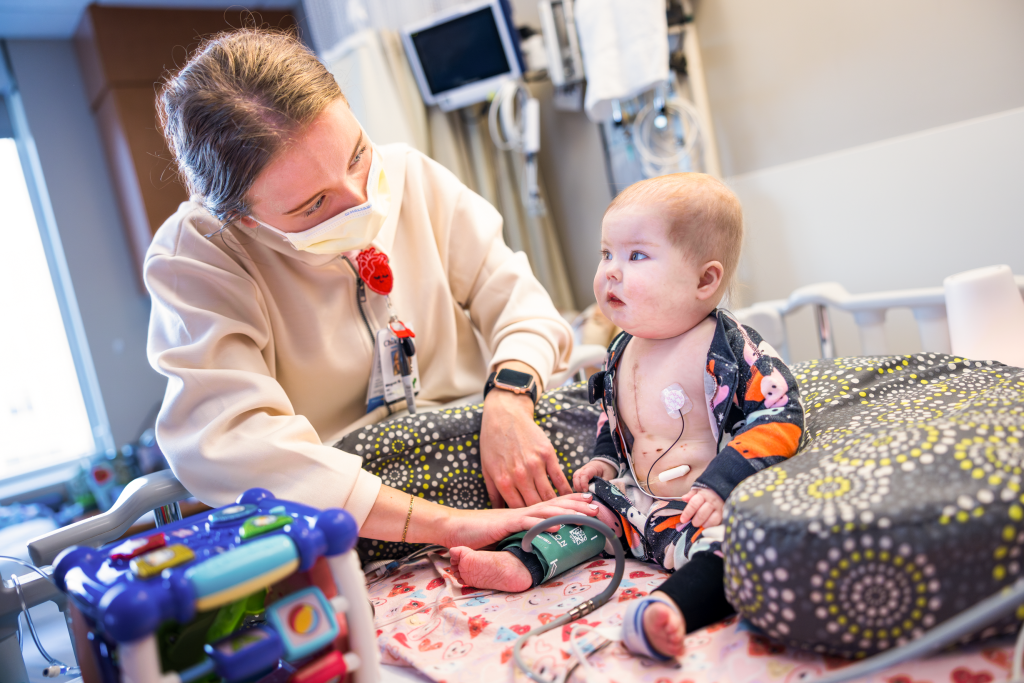
The infant pictured here is not the patient mentioned in the quote below.
The project implemented a modified simulation-based mastery learning (SBML) curriculum to boost confidence and decrease anxiety. The SBML intervention allowed caregivers to demonstrate home monitoring program skills in a simulated environment. The curriculum leveraged manikin-based and video-based immersive settings to practice and assess caregiver performance. Instructors also used a teach-back strategy, where caregivers repeat back information provided to them in their own words.
After participating in this simulation-based training, all caregivers met minimum passing standards, and 90% reported decreased anxiety and increased confidence.
One family even shared the following, “We really do appreciate the extra stimulation training on emergent situations. In hindsight, this was what gave us the confidence to save our son’s life. He had two cardiac arrests last week, but we got him back with bagging.” EMTs then arrived to continue care, including performing a trach change. The patient’s mom continued, “Today, I am so thankful and happy to report he is ok. No ribs broken, no fluid in the heart or chest cavity, everything went so smoothly. I don’t know what we would have done without extra training in emergency situations.”
After participating in this simulation-based training, all caregivers met minimum passing standards, and 90% reported decreased anxiety and increased confidence.
One family even shared the following, “We really do appreciate the extra stimulation training on emergent situations. In hindsight, this was what gave us the confidence to save our son’s life. He had two cardiac arrests last week, but we got him back with bagging.” EMTs then arrived to continue care, including performing a trach change. The patient’s mom continued, “Today, I am so thankful and happy to report he is ok. No ribs broken, no fluid in the heart or chest cavity, everything went so smoothly. I don’t know what we would have done without extra training in emergency situations.”
While this is the first intervention of its kind, Heidi, Jocelyn, Jamie and the broader care team are hopeful it will improve patient outcomes during this tenuous stage.
Their research was published in the Journal of Pediatric Health Care.
Chronic ventilation roadmap tracks patient progress
Patient families, especially those with a chronically ill child, face many difficult decisions on their care journey. They must weigh what’s best for their child right now with other considerations like long-term quality of life, their cultural or religious beliefs and so much more. To assist the care team and the family in one of these complex decisions, a nurse from the cardiovascular intensive care unit (CVICU) formed a multi-disciplinary team to develop a chronic ventilation roadmap.
Seeking chronic ventilation involves a number of specialties; the roadmap brings together the necessary parties and provides an overview of the potential steps taken before making a decision, including a pulmonary consult, an ethics consult (if needed), a social assessment, caregiver education and more. It also helps keep track of where the patient and family are on the path to going home.
Children’s Minnesota nurses pride themselves on providing ample patient education to empower kids and their families to actively participate in their health care.
This roadmap does not replace attending physician expertise or patient/family autonomy, nor will every patient follow the pathway as written.
Limited English proficiency (LEP) communication boards create stronger partnerships with patient families
Children’s Minnesota provides a framework to help effectively educate patients and families, including strategies for planning, supporting and coordinating educational resources.
A new tool, limited English proficiency (LEP) communication boards, create a partnership with patient families to connect on their requests and needs during their clinic visit or hospital stay. While the LEP communication boards do not replace patient family education or the need for an interpreter in providing medical information, they are deeply helpful when relaying simple messages, tasks or needs to or from frontline staff like:
- My child needs a shower/bath.
- I want to hold my child.
- Please call spiritual care.
- I am going to be back soon.
Equipped with photos and phrases translated to Arabic, Hmong, Karen, Somali, Spanish and American Sign Language, the LEP boards help prevent miscommunication and frustration, improve overall patient experience and increase access to care. Children’s Minnesota is proud to create an inclusive, safe environment where everyone feels heard, valued, respected and supported.