

The NOISE Committee: Promoting safety with a smile
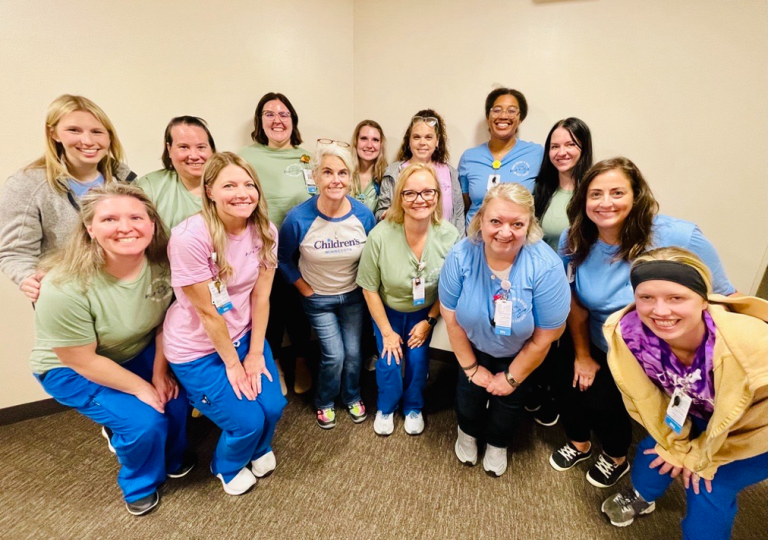
What does the Grease soundtrack, a hand sanitizer Halloween costume and a group of about 20 neonatal nurses at Children’s Minnesota have in common? On the surface, not much. When you look closer, they are all key to ensuring the safest, highest quality care for our tiniest, most fragile patients.
The NOISE Committee
The Neonatal Outcomes in Infection and Safety Everywhere (NOISE) Committee was formed to encompass all patient safety work across the neonatal community, including the Minneapolis, St. Paul and Mercy NICUs; the special care nursery; and the infant care center.
Formerly known as the PIT/STOP Committee, this advisory group was reinvigorated in spring 2024 with a new name, additional members and a wider scope. Interested nurses applied and then completed central line associated bloodstream infection (CLABSI) champion training and safety coach training.
These courses equipped them with tools to assess central lines and initiate real-time conversations with their peers when rounding on the units. This hands-on approach ensures the best safety practices are reinforced at the bedside through thoughtful 1:1 coaching. For a broader reach, the committee members also disseminate safety learnings and a monthly newsletter called The Noisemaker to all neonatal staff.
The committee’s efforts primarily focus on CLABSI, unplanned extubation, hospital-acquired pressure injuries (HAPI) and hand hygiene.
The hand hygiene campaign
Hand hygiene is health care workers’ first line of defense against infection. In revisiting this fact, the NOISE Committee noticed the number of monthly hand hygiene audits in each unit was low.
A hand hygiene audit assesses the compliance of any employee from any discipline on any unit. Anyone can perform hand hygiene audits after completing the e-learning module. The observation includes whether they use alcohol rub or soap/water and if they wash before entering a room, before touching a patient and after performing care.
The committee sought to promote this crucial practice in a fun way. So, they launched a friendly competition between neonatal units. And when Children’s Minnesota nurses are told to get creative, have a good time and promote patient safety, they do just that!
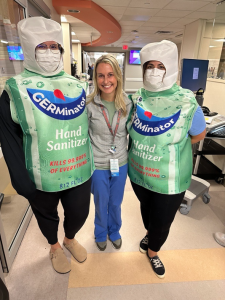
Two committee members rounded on their unit in hand sanitizer Halloween costumes as their not-so-subtle reminder to their colleagues. Others renamed a Grease soundtrack classic, penned new lyrics and took to the stage to perform a rendition of Summer Sudsin’ (to the tune of Summer Lovin’) to promote hand hygiene. The music therapy team wrote the lyrics and offered their vocal stylings to lip sync to.
At the end of each quarter, a trophy is awarded to the neonatal unit with the most audits. Along the way, so many wins have already been tallied. Hand hygiene audits are up, NICU babies are more protected against infection and the team feels closer than ever.
Progress made on workplace violence prevention
Children’s Minnesota is committed to delivering high-value care that is safe, timely, effective, efficient, equitable and patient-centered; and our kid experts help us deliver that.
We know that safety, especially workplace violence prevention, has been a primary concern for staff. Throughout the last couple of years, we’ve made changes to our systems and processes, and have adjusted based on what we learn, to address this important issue. Below are actions we’ve taken and progress we’ve made.
- Workplace Violence Prevention Training has been added to Annual Mandatory Training.
- The inpatient mental health unit opened in November 2022 and the St. Paul ER mental health space was remodeled in August 2023. These spaces were designed with the utmost safety of patients and staff in mind.
- The Pinpoint staff duress system, which is used to locate and protect both staff and patients, was rolled out. The pinpoint badge has two buttons; the smaller button can be used for staff assists while the larger button is used to initiate a Code Green. When the button is pressed, it sends the exact location of the staff safety alert to screens and lights up an overdoor light.
- The Welle Crisis Prevention and De-escalation Training has been rolled out and is offered on an ongoing basis. This program teaches staff proactive intervention skills to identify early behaviors which could lead to violent outbursts as well as techniques for diffusing escalating behaviors. This program strives to create environments where restraints are unnecessary, assaults are unknown, and where everyone feels safe, physically and emotionally.
- We made several Code Green improvements, including defining Code Green roles, developing Code Green carts and switching codes over to plain language so they are more easily understood by staff, patients and families.
Children’s Minnesota continues to meet regularly with multidisciplinary teams — including clinical nurses — to review safety trends, adjust protocols and support staff. Their voices are central to every decision.
The launch of elopement and behavioral risk precautions
Creating and maintaining a culture of physical and psychological safety at Children’s Minnesota is a top priority. For patients, this kind of culture is crucial to reducing medical errors, eliminating patient harm and improving outcomes. For staff, it helps reduce injuries, avoid burnout and improve well-being. In 2024, we focused on improving awareness of behavioral risks by implementing elopement and behavioral risk precaution protocols.
Elopement precautions
In May 2024, the elopement precaution protocols were established and shared with nursing staff. Elopement in the health care setting is legally defined as a patient who is incapable of adequately protecting themselves, and who departs the health care facility unsupervised and undetected. Risk factors include:
- A history of elopement
- Significant threats or ideation of elopement
- Demonstrating at-risk behaviors like standing near secure doors, impersonating staff or visitors and threatening to elope
- Impulsivity or anger about their involuntary or legal status
- Clinical determination made by staff based on patient presentation
Once a nurse or other care team member has identified a risk factor, the nurse is empowered to initiate the elopement precaution protocol to immediately implement safety interventions.
The care team then convenes to determine the patient’s elopement status, either “stop” or “redirect.” The information is then shared through the care team using door magnets, unit door signage, a charge nurse data sheet and tiered huddles. Staff are also expected to carry their hospital phone and wear a Pinpoint badge, which is used to locate and protect both staff and patients.
Behavioral risk precautions
In November 2024, behavioral risk screening and precaution protocols launched. The goals of the protocols are to help prevent behavioral escalations and ensure patient and staff safety. Screening questions were added to the ED rooming screening PowerForm and admission assessments PowerForms, which assist nurses in determining if a patient needs to be on a behavioral risk precaution and how to place the appropriate protocol order set.
The type of behavioral risk precaution protocols include:
- Aggression precaution protocol
- Sexually acting out precaution protocol
- Self-harm precaution protocol
- Suicide – high risk precaution protocol
- Suicide – moderate risk precaution protocol

When the appropriate protocol is placed, behavioral risk precautions are displayed in various clinical software. Visual signage is also placed outside the patient’s door to encourage all staff members to ‘Bee Alert’ to violence risks.
These precautions and protocols inch us closer to creating an environment free from violence and harm, for all who engage with us.
Epilepsy monitoring services moves to 8th floor Minneapolis
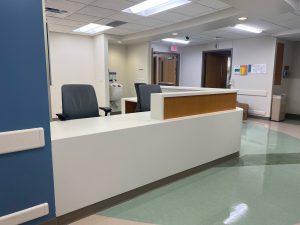
To collocate neuroscience support, resources and equipment on one campus, Children’s Minnesota epilepsy monitoring services moved to an existing remodeled 17-bed unit on the 8th floor of the Children’s Minnesota Hospital in Minneapolis. It was previously located on the 5th floor unit on the Children’s Minnesota Hospital in St. Paul.
The 8th floor Minneapolis unit was remodeled and re-opened on Aug. 22, 2023. The refresh of the unit includes
- An updated nurse station.
- New electroencephalogram (EEG) tech monitoring space.
- New neurodiagnostic testing room.
- New epilepsy team workroom.
- Updated patient playroom and family lounge.
- Updated storage room.
- Installation of monitoring equipment.
The 8th floor team cares for general medical surgical, and neurodiagnostic monitored and sEEG (Steroelectroencephalography) patients. The team that supports the 8th floor are a mix of internal transfers from our acute care units and float teams, as well as new employees who are new graduates or experienced neuroscience nurses.
Children’s Minnesota is proud to provide high-quality, holistic care to well over 700 patients every year in our Level 4 Epilepsy Center.
Restraint chair training promotes a safer care environment
In October 2024, the Minneapolis emergency department, 7th floor, float team and security joined together to orient 60% of the total nursing and bedside security staff to the safety restraint chair in one week. The remainder were orientated by the end of November.
The safety restraint chair was first implemented in the inpatient mental health unit when it opened. The rest of St. Paul had access to this tool beginning in early 2024; it was then brought over to Minneapolis in Q3 2024.The restraint chair is preferred, as opposed to 4-point restraint, to decrease patient vulnerability and provide more trauma-informed care.
Children’s Minnesota defines trauma-informed care as a framework of thinking and interventions that are directed by a thorough understanding of the profound neurological, biological, psychological and social effects trauma has on an individual – recognizing a person’s constant interdependent needs for safety, connections and ways to manage emotions and or impulses.
Training consisted of a 30-minute in-person education session, accompanied by a virtual video created by the Center for Professional Development and Practice (CPDP) and the inpatient mental health unit.
Superusers and clinical educators embraced this new and preferred tool to protect patients and staff, creating lasting change and inspiring one another to make safer decisions.