
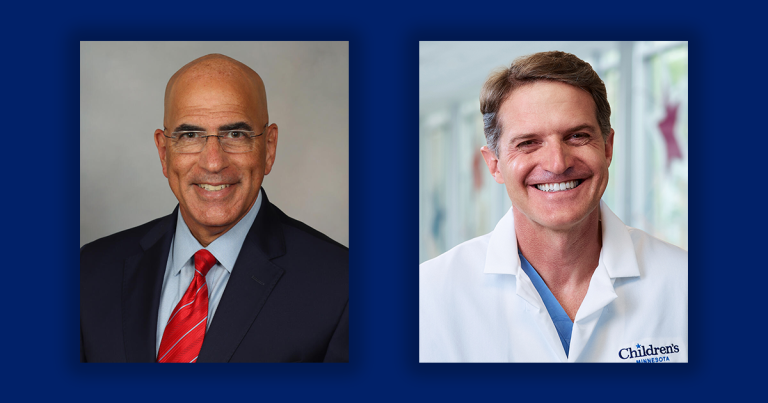
The Mayo Clinic – Children’s Minnesota Cardiovascular Collaborative is participating in a first-of-its-kind clinical trial evaluating a bioengineered blood vessel graft designed to grow with pediatric patients born with discontinuous branching pulmonary arteries, a rare congenital heart defect. Joseph Dearani, MD, director of pediatric and adult congenital heart surgery at Mayo Clinic, is the principal investigator of the study titled “Phase 1/2 Clinical Trial of Biologically-engineered Growing Heart Conduit for Repair of Discontinuous Pulmonary Arteries.” Robroy MacIver, MD, congenital heart surgeon and director of the heart failure and heart transplant program at Children’s Minnesota, will work closely with Dr. Dearani.
The bioengineered graft is the result of years of collaboration between Mayo Clinic and Children’s Minnesota, bringing together expertise in pediatric cardiovascular care and research.
For more than a decade, Dr. MacIver has helped advance the technology through graft design, preclinical studies and regulatory development.
“This trial is the result of many years of collaboration among surgeons, scientists and engineers who shared a vision of creating a blood vessel graft that could become part of a child’s own body,” Dr. MacIver said. “If successful, this approach could help reduce the need for future surgeries and open the door to a new generation of regenerative therapies for children with congenital heart disease.”
Currently, children with discontinuous branching pulmonary arteries who require a blood vessel graft often outgrow it and need additional surgeries to implant a larger graft. Unlike traditional grafts that do not grow, the bioengineered graft is designed to repopulate with the patient’s own cells and potentially grow as the child grows. If successful, that could reduce the need for future replacement surgeries.
To create the graft, researchers grow a blood vessel-like tube from donor skin cells in a laboratory. The cells are then removed, leaving behind a biologic framework. After implantation, the patient’s own cells can move into that framework and help transform it into a living blood vessel. Researchers hope this process will allow the graft to grow along with the child.
The trial is evaluating the safety and performance of the graft in six children ages 6 months to 2 years who require surgical repair of discontinuous branching pulmonary arteries. In this condition, a portion of the pulmonary artery is absent and must be reconstructed to restore blood flow between the heart and lungs. Researchers monitor patients following implantation to evaluate the graft’s safety and performance over time.
Learn more about the trial here.