
Key points:
- Early referrals and multidisciplinary collaboration, involving OB-GYN, pediatric cardiology, maternal-fetal medicine and genetic counseling, enabled timely diagnosis and coordinated care across Minnesota health systems for Lucy’s complex congenital heart defects.
- Lucy’s treatment included neonatal open-heart surgery, balloon valvuloplasty and the implantation of the first FDA-approved expandable heart stent for infants in Minnesota.
Heidi and her husband Cameron, from Duluth, Minn., were thrilled to be expecting their third child, Lucy. However, their excitement turned to concern when the 20-week fetal anatomy scan revealed something unusual about Lucy’s heart.
Signs of congenital heart defects
During the scan at Aspirus St. Luke’s, the team couldn’t get clear images of Lucy’s heart. However, Heidi’s OB-GYN, Taylor Swanson, MD, did notice a difference between the left and right ventricles and referred her to Essentia Health for a fetal echocardiogram.
Heidi and Cameron were anxious but hopeful that it was nothing serious. But at the echo, Kelly Aarsvold, MD, pediatric cardiologist at Essentia, said she suspected that Lucy had coarctation of the aorta, along with a bicuspid aortic valve.
Referral to Midwest Fetal Care Center
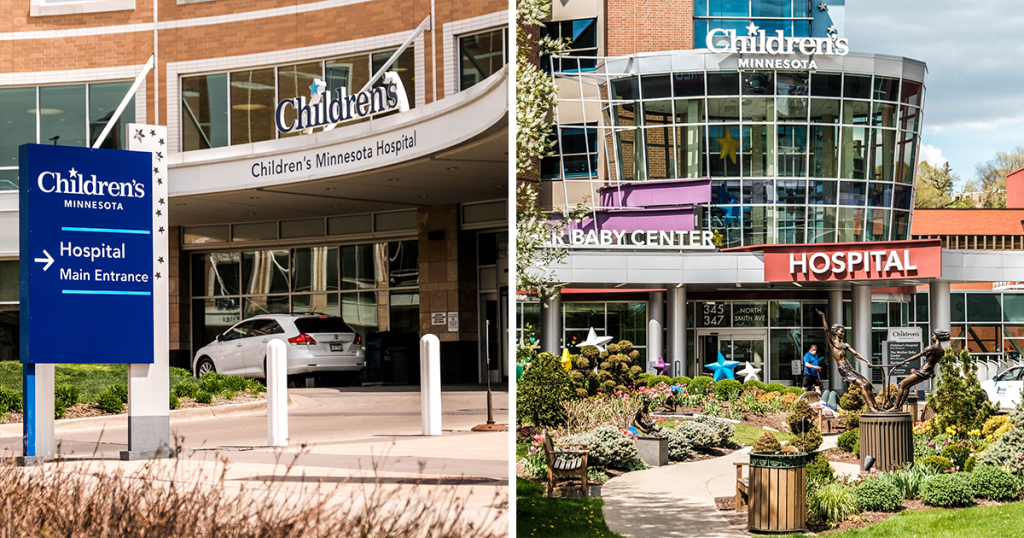
Dr. Aarsvold referred Heidi to Midwest Fetal Care Center (MWFCC), a collaboration between Allina Health and Children’s Minnesota.
At MWFCC, Heidi received several scans and tests and met with a genetic counselor, a nurse and David Lynch-Salamon, MD, a maternal-fetal medicine expert with Minnesota Perinatal Physicians, and David Gremmels, MD, chief of cardiology and a fetal cardiology specialist at Children’s Minnesota. Dr. Gremmels agreed with Dr. Aarsvold’s assessment that it looked like Heidi’s baby had coarctation of the aorta. They would know for sure once she was born.
Ongoing pregnancy care and Lucy’s birth
Heidi’s pregnancy continued with regular monitoring, most of which she was able to do close to home in Duluth with Drs. Swanson and Aarsvold. The plan was for her to deliver at The Mother Baby Center in Minneapolis, another partnership between Allina Health and Children’s Minnesota. As her delivery date approached, she and Cameron relocated and stayed with family in the Minneapolis/St. Paul metro.
Lucy was born at 39 weeks in October 2024. Heidi was able to hold her new baby for a few minutes. Then, Lucy was seamlessly brought to Children’s Minnesota’s Level IV neonatal intensive care unit (NICU) for evaluation. After that, she was taken to the cardiovascular intensive care unit (CVICU). There, the medical team confirmed the severity of her congenital heart defect. Turns out, Lucy had three issues: coarctation of the aorta, hypoplastic aortic arch and a unicuspid aortic valve.
Heart surgery and going home
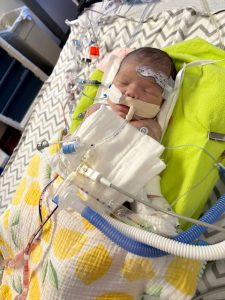
At just 5 days old, Lucy had open-heart surgery to correct the coarctation and fix her aortic arch. The surgery was successful, and Lucy was recovering well. But a follow-up echo showed that her aortic valve was not functioning properly. At 2 weeks old, she went in for a balloon valvuloplasty performed by Marko Vezmar, MD, medical director of interventional cardiology. In the cardiac catheterization (cath) lab, Dr. Vezmar guided a tiny balloon into the narrow valve and inflated it, improving blood flow. Lucy was able to go home a week later.
Lucy the trailblazer
In June 2025, Lucy faced another challenge when her aorta began to narrow again. Through a Facebook group, Heidi heard about the Minima heart stent from Renata Medical. It’s the first heart stent specifically designed for babies approved by the Food and Drug Administration (FDA). She asked Dr. Aarsvold at Essentia about it, who brought it to Dr. Vezmar. After detailed evaluation with a CT scan and discussion with stent developers, the cardiac cath lab team at the Children’s Minnesota determined that Lucy would be an ideal candidate.
A few weeks later, Dr. Vezmar and Rodrigo Rios IV, MD, pediatric cardiologist, successfully implanted the device and Lucy became the first baby in Minnesota to receive the Minima stent.
“Typically, the standard of care was to use stents designed for adults in patients like Lucy. This stent, which is minimally invasive, can be gradually expanded as the child grows — all the way to adult size,” Dr. Vezmar describes.
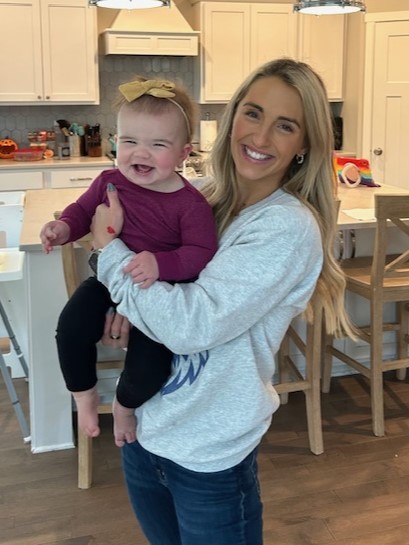
It could be a couple years before Lucy returns to the cath lab to have the stent expanded. She’ll also need another surgery in the future to fix her aortic valve. But today, Lucy is a happy, healthy child who celebrated her first birthday in October 2025.
“Lucy’s story is one example of what’s possible when we collaborate across disciplines and health systems,” Dr. Vezmar said. “From diagnosis to delivery and treatment, our coordinated efforts across various specialties ensured that Lucy and her family received comprehensive and compassionate care, leading to a good outcome.”